
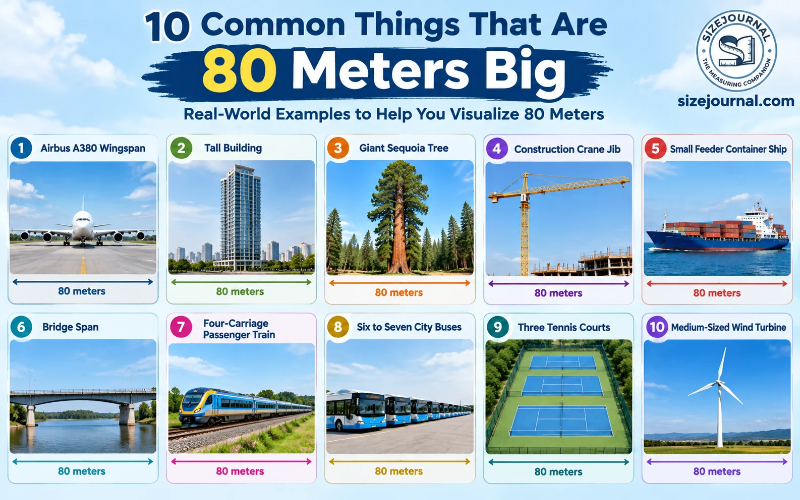
Have you ever wondered how big 80 meters really is? Measuring 80 meters on paper might not tell you much, but comparing this distance with familiar buildings, vehicles, trees, and other large structures makes it much easier to understand. Eighty meters is a considerable length or height. It is enough to stretch across a large construction site, reach the height of a tall building, or match the wingspan of one of the world’s largest passenger airplanes.
The interesting thing about 80 meters is that it can represent different dimensions depending on what you are measuring. It might be the height of a giant tree, the length of a bridge, the wingspan of an aircraft, or the reach of a construction crane. These comparisons help turn an otherwise abstract measurement into something you can recognize in everyday life.
If you have been searching for how big is 80 meters, this guide will help you understand the measurement through 10 interesting real-world examples. From enormous airplanes and tall trees to long trains and impressive bridges, each comparison offers a different way to visualize 80 meters.
Let’s look at some familiar and fascinating things that are approximately 80 meters big!
Quick Answer: How Big Is 80 Meters?
80 meters is equal to 262.47 feet, approximately 87.49 yards, or 8,000 centimeters. It is a substantial measurement that can be understood by comparing it with a tall building, a giant tree, or a large passenger airplane.
Here are some quick facts about 80 meters:
- 80 m in feet: 262.47 feet
- 80 m in inches: 3,149.61 inches
- 80 m in centimeters: 8,000 centimeters
- 80 m in kilometers: 0.08 kilometers
- 80 m in yards: 87.49 yards
- 80 m in miles: Approximately 0.0497 miles
1. The Wingspan of an Airbus A380 ✈️
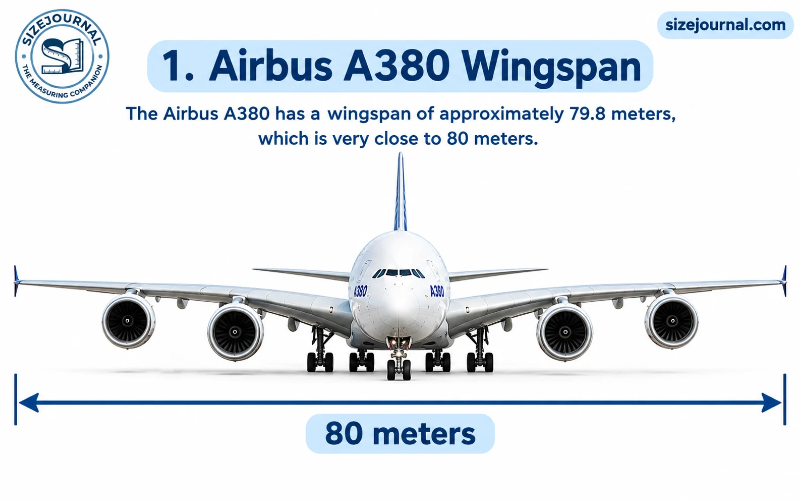
One of the most impressive comparisons for understanding 80 meters is the wingspan of the Airbus A380. This enormous passenger aircraft is known for its double-deck design, large passenger capacity, and remarkable size.
The Airbus A380 has a wingspan of approximately 79.8 meters, making it almost exactly 80 meters from one wingtip to the other. This makes it one of the closest real-world examples of an object that measures 80 meters.
When you stand near an Airbus A380 at an airport, its enormous wings stretch across an impressive area. The aircraft is designed to carry hundreds of passengers on long-distance international flights, and its wings provide the lift necessary to keep this massive machine in the air.
Its wingspan is particularly useful for understanding how wide 80 meters really is. Imagine standing at one wingtip and looking all the way across to the opposite wingtip. That entire distance is nearly 80 meters.
Interesting Facts About the Airbus A380
- Its wingspan is approximately 79.8 meters.
- Its overall length is approximately 72.7 meters.
- It has two full-length passenger decks.
- It is among the largest passenger aircraft ever built.
- Its wings are designed to support an enormous aircraft during flight.
How it compares to 80 meters: The Airbus A380’s wingspan is only about 20 centimeters shorter than 80 meters. It is an excellent example of this measurement in real life.
2. An 80-Meter-Tall Building 🏢
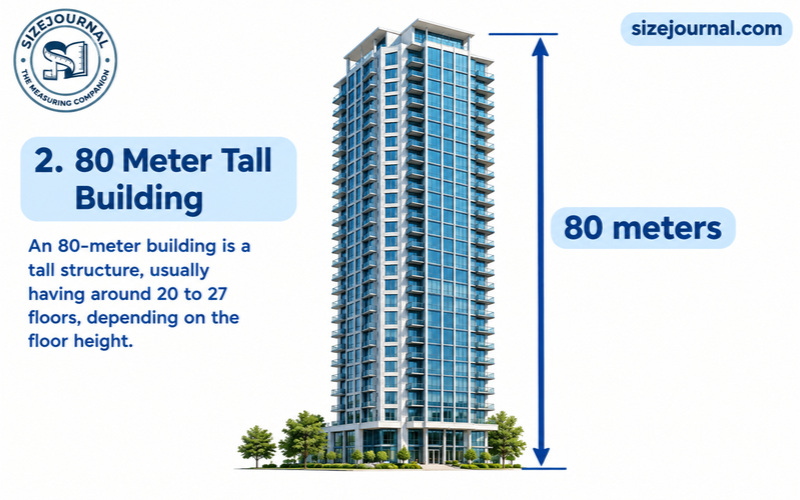
Buildings are another excellent way to visualize 80 meters. A structure measuring 80 meters in height would be considered a tall building in many cities, particularly when compared with ordinary residential houses and smaller commercial properties.
Depending on the design and floor-to-floor height, an 80-meter building could have approximately 20 to 27 floors. For example, if each floor measures around 3.2 meters from one level to the next, the building would have approximately 25 floors.
Think about walking along a street surrounded by ordinary houses and then looking up at a building that reaches 80 meters into the sky. The difference would be remarkable. The building would tower above nearby low-rise structures and could become a noticeable feature of the local skyline.
Buildings of this height commonly contain apartments, offices, hotels, or a combination of commercial and residential spaces.
Why Is an 80-Meter Building So Tall?
An 80-meter building requires careful planning, strong structural materials, and an appropriate foundation. Engineers must consider wind pressure, building weight, emergency exits, elevators, and other safety requirements.
The height also influences how people experience the building. Residents or workers on the upper floors can enjoy elevated views of surrounding streets and neighborhoods.
How it compares to 80 meters: An 80-meter building measures exactly 80 meters from its base to its highest point. It is one of the easiest ways to understand this height because multi-story buildings are familiar landmarks in many cities.
3. A Giant Sequoia Tree 🌳
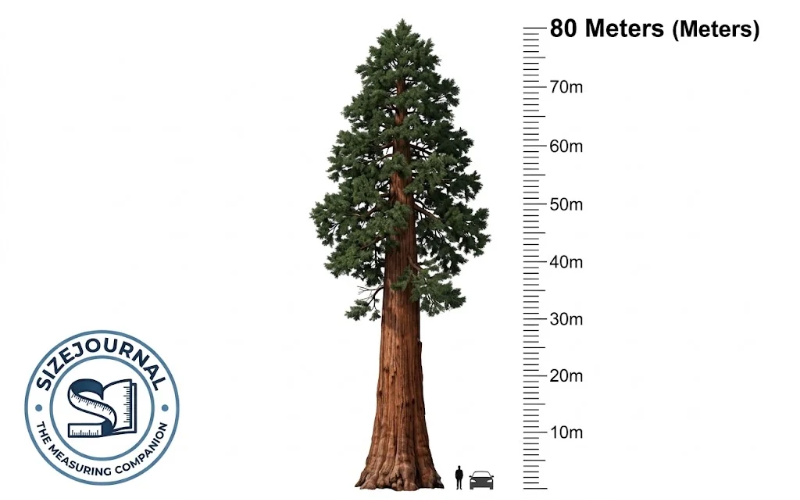
Trees can grow much taller than most people imagine. While ordinary garden trees may reach heights of 5 to 15 meters, some giant sequoias in California grow to heights of around 80 meters or more.
The giant sequoia is famous for its enormous trunk, impressive height, and remarkable lifespan. These trees grow naturally in the western Sierra Nevada mountains of California, where suitable soil, rainfall, and climate allow them to reach extraordinary sizes.
An 80-meter-tall sequoia would be an incredible sight. Its trunk would rise high above the forest floor, while its branches would spread outward to create a large canopy. Looking up from the base, it would be difficult to see the top clearly without tilting your head far backward.
Some giant sequoias grow considerably taller than 80 meters, although their most famous feature is often their enormous trunk volume rather than height alone.
What Makes Giant Sequoias Special?
- They are among the largest trees in the world by volume.
- They can live for thousands of years.
- Their thick bark helps protect them from many forest fires.
- They grow naturally in California’s Sierra Nevada mountains.
- Some specimens reach heights exceeding 80 meters.
How it compares to 80 meters: An 80-meter-tall giant sequoia would reach approximately 262 feet into the air. This is similar to the height of a 25-story building, making it a fantastic natural comparison.
4. A Large Construction Tower Crane 🏗️
Construction tower cranes are commonly seen at major building projects. They are designed to lift heavy construction materials, move equipment, and transport supplies to different parts of a building site.
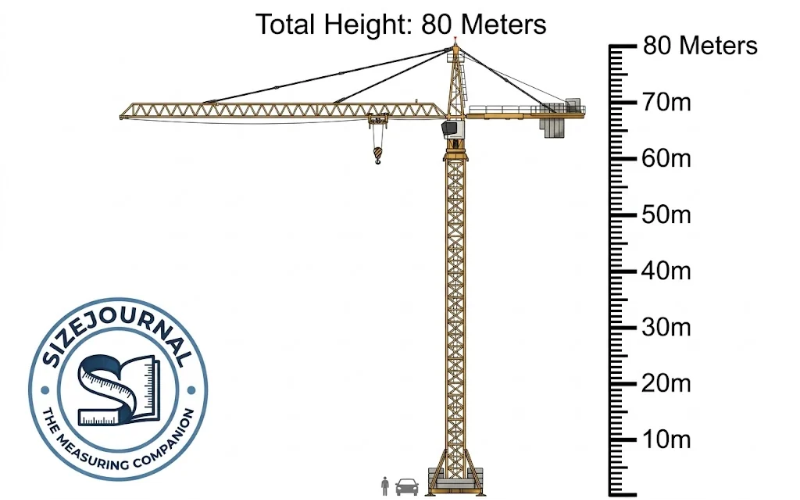
One interesting feature of a tower crane is its horizontal jib, which can extend a considerable distance from the central mast. Depending on the model, some large cranes have working jibs that reach approximately 80 meters.
An 80-meter crane jib would stretch across a substantial construction area. It could reach over several sections of a building project, allowing workers to move materials without constantly repositioning the entire crane.
Unlike the height of a building, this comparison focuses on horizontal reach. Imagine measuring a straight line from the crane’s central tower to the end of its jib. That distance could be around 80 meters.
How Does a Tower Crane Work?
A tower crane generally consists of several important parts:
- Mast: The tall vertical structure that supports the crane.
- Jib: The horizontal arm that extends outward.
- Counter-jib: The shorter arm that carries counterweights and machinery.
- Trolley: The component that moves along the jib.
- Hook: The equipment used to lift construction materials.
Large tower cranes are especially important when constructing skyscrapers, bridges, industrial facilities, and other major structures.
How it compares to 80 meters: A crane with an 80-meter jib can reach approximately 262 feet horizontally. It provides a practical example of how far 80 meters extends across a construction site.
5. A Small Feeder Container Ship 🚢
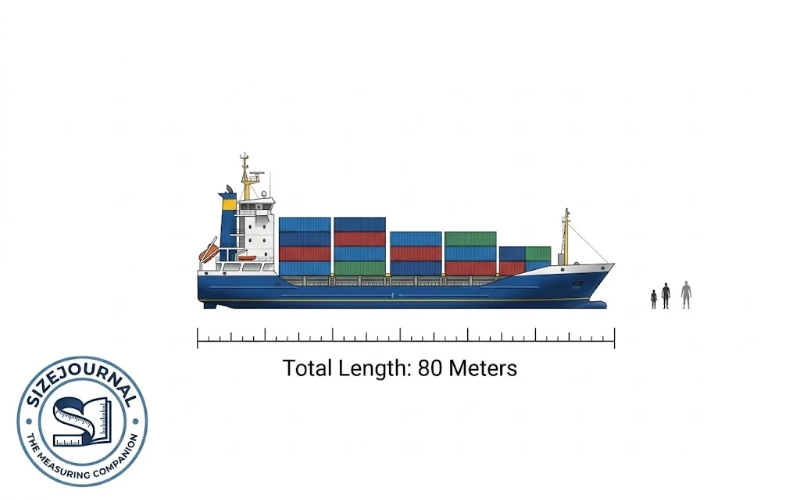
Ships come in many different sizes, ranging from small fishing boats to enormous cargo vessels. A small feeder container ship can be approximately 80 meters long, making it another useful comparison for understanding this measurement.
Feeder container ships are used to transport shipping containers between smaller ports and larger shipping hubs. They help connect regional ports with major international shipping routes.
An 80-meter-long vessel might carry a relatively modest number of containers compared with the giant container ships that travel across major oceans. However, it is still a substantial vessel when viewed from the shore.
Its length can be understood by imagining a straight line from the front of the ship, known as the bow, to the back, known as the stern.
Why Are Feeder Ships Important?
These vessels play an important role in the global shipping industry.
- They transport containers between regional ports.
- They connect smaller harbors with major shipping terminals.
- They help distribute goods across different shipping networks.
- They support international trade and commercial transportation.
- They can operate in ports that are unsuitable for much larger vessels.
How it compares to 80 meters: A small feeder container ship measuring approximately 80 meters from bow to stern is almost the same length as the measurement we are exploring.
6. A Medium-Sized Pedestrian or Road Bridge Span 🌉
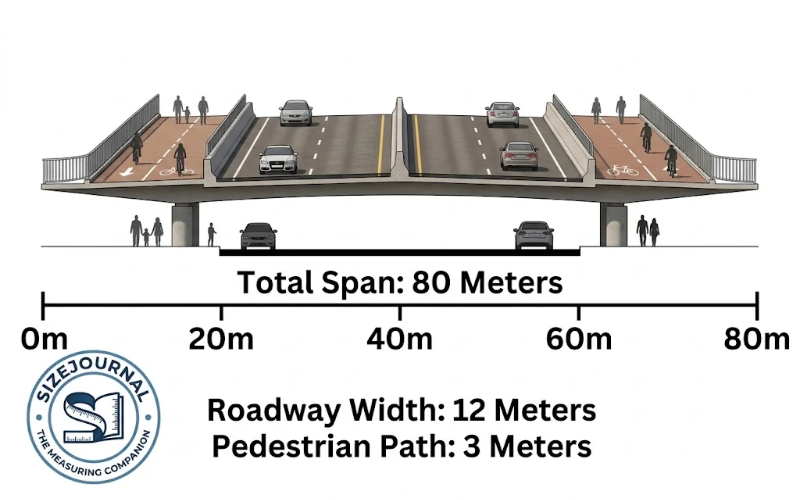
Bridges provide another interesting way to understand how big 80 meters is. Although some bridges stretch for several kilometers, many smaller road and pedestrian bridges have individual spans measuring around 80 meters.
A bridge span is the distance between two supporting points, such as piers or abutments. An 80-meter span would allow a bridge to cross a significant gap without requiring a support structure in the middle.
For example, imagine a bridge crossing a small river, a wide drainage channel, or a section of uneven land. An 80-meter span would create a considerable crossing distance.
Bridges of this size can be built using different materials, including reinforced concrete, structural steel, and combinations of both.
Where Can You Find Bridges of This Size?
An 80-meter bridge span may be used in:
- Road bridges crossing rivers.
- Pedestrian bridges connecting two areas.
- Railway bridges over waterways.
- Industrial access bridges.
- Bridges crossing valleys or drainage channels.
The actual length of a bridge can be greater than 80 meters if it contains multiple spans or approaches.
How it compares to 80 meters: A single bridge span measuring 80 meters covers the same distance as our target measurement. Looking across the gap from one support to the next gives a clear idea of its size.
7. A Four-Carriage Passenger Train 🚆
Passenger trains are familiar forms of transportation in many countries. They are used to move people between cities, towns, and urban neighborhoods.
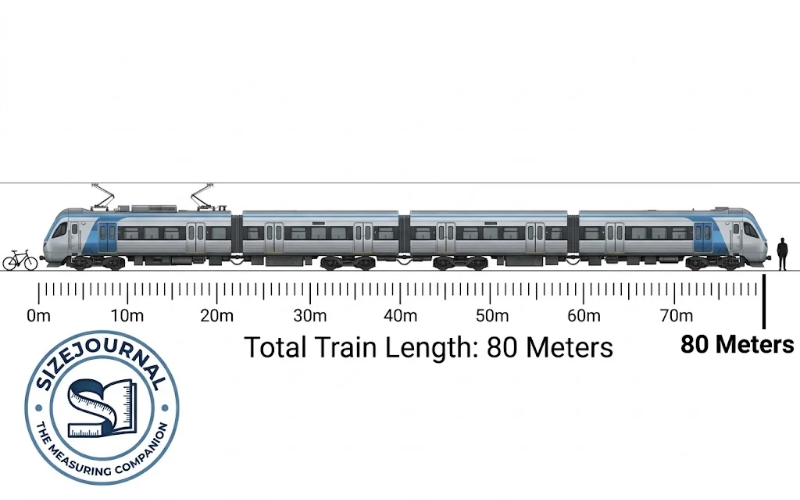
A four-carriage passenger train can measure approximately 80 meters in total length, depending on the type of railway cars used.
For example, if each carriage is approximately 20 meters long, connecting four carriages together creates a train measuring 80 meters from the front to the back.
This comparison is particularly useful because it turns a large measurement into several smaller sections. Instead of trying to imagine one continuous 80-meter line, you can think about four connected railway carriages.
Passenger trains come in different configurations. Some have shorter carriages, while others use longer vehicles designed for intercity travel. Therefore, the exact length depends on the train model.
How Much Space Does an 80-Meter Train Need?
A train of this length needs a considerable amount of platform space. It also requires enough railway track to accommodate the entire vehicle when stopping at a station.
The length can influence:
- How many passengers the train can carry.
- Which platforms it can use.
- How it operates on different railway routes.
- How much space is required at railway stations.
How it compares to 80 meters: Four passenger carriages measuring approximately 20 meters each would create a combined length of 80 meters.
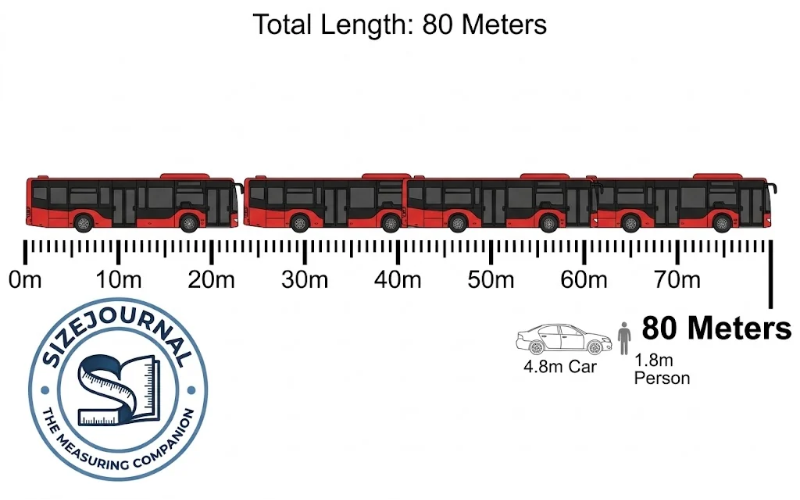
8. Six to Seven City Buses Parked in a Straight Line 🚌
City buses are a common sight on busy roads. They transport passengers between residential areas, business districts, schools, shopping centers, and other destinations.
A typical full-size city bus is approximately 11 to 12 meters long. If six or seven buses are parked end-to-end in a straight line, their combined length can come close to 80 meters.
For example:
- One bus: approximately 12 meters.
- Two buses: approximately 24 meters.
- Three buses: approximately 36 meters.
- Four buses: approximately 48 meters.
- Five buses: approximately 60 meters.
- Six buses: approximately 72 meters.
- Seven buses: approximately 84 meters.
This comparison makes 80 meters easier to visualize because most people have seen city buses on the road.
Imagine seven buses parked one after another in a straight line. The entire row would stretch across a large section of a street or parking area.
Why Is This Comparison Useful?
Unlike an enormous building or airplane, buses are familiar vehicles that people encounter regularly. Their individual lengths make it easier to estimate the combined distance.
The comparison also highlights how much road space is required when several large public transportation vehicles are parked together.
How it compares to 80 meters: Six standard 12-meter buses cover approximately 72 meters, while seven cover approximately 84 meters. Therefore, 80 meters is slightly longer than six buses and slightly shorter than seven.
9. Three Regulation Tennis Courts Placed End-to-End 🎾
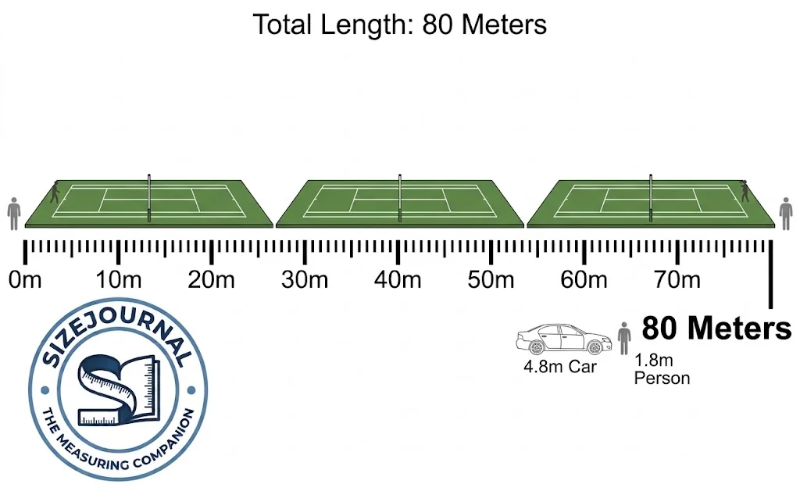
Tennis courts are another interesting way to understand large measurements. A regulation tennis court has a playing length of approximately 23.77 meters, measured between the two baselines.
If you place three regulation tennis courts end-to-end, their combined playing length would be approximately 71.31 meters.
That is already quite close to 80 meters!
You would need another 8.69 meters to reach the full measurement. This makes three tennis courts a helpful reference for estimating how much space 80 meters covers.
A tennis court is divided into two halves by a net, with service lines and baselines marking different playing areas. Although the court is relatively small compared with a large sports stadium, placing multiple courts together creates a considerable distance.
Understanding the Tennis Court Measurement
Here is the simple calculation:
- One tennis court: 23.77 meters long.
- Two tennis courts: 47.54 meters long.
- Three tennis courts: 71.31 meters long.
- Four tennis courts: 95.08 meters long.
This comparison is useful because tennis courts have standardized playing dimensions, making them a reliable reference.
How it compares to 80 meters: Three regulation tennis courts placed end-to-end measure approximately 71.31 meters. An 80-meter distance is about 8.69 meters longer than this arrangement.
10. A Medium-Sized Wind Turbine 🌬️
Wind turbines are impressive structures that convert wind energy into electricity. Their tall towers and enormous rotating blades make them easy to recognize in open landscapes and wind farms.
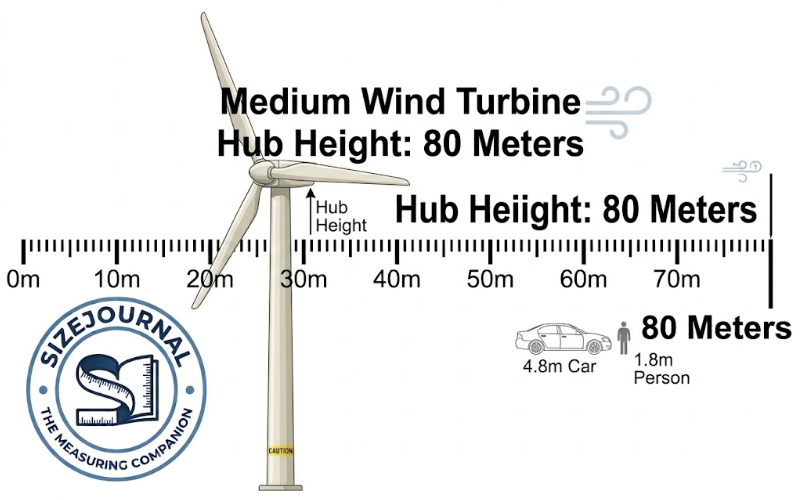
A medium-sized wind turbine can have a total height of approximately 80 meters from the ground to the highest point reached by its blade tip. However, the exact dimensions vary considerably depending on the turbine model.
Some turbines have hub heights of around 50 to 60 meters, while their blades extend many meters beyond the central hub. When a blade points vertically upward, the total height can approach or exceed 80 meters.
Wind turbines are designed to capture moving air and use it to rotate a generator. This electricity can then be supplied to homes, businesses, and industrial facilities.
What Makes Wind Turbines So Tall?
The height of a wind turbine is important because wind conditions often become stronger and more consistent above ground level.
Their main components include:
- Tower: The tall supporting structure.
- Nacelle: The housing that contains the generator and other machinery.
- Rotor: The rotating assembly of blades.
- Blades: The large aerodynamic components that capture wind energy.
- Foundation: The structure that supports the entire turbine.
Wind turbines can be found in rural areas, coastal regions, and offshore wind farms.
How it compares to 80 meters: A turbine with a total blade-tip height of approximately 80 meters provides an impressive vertical comparison. Its height is similar to that of a 25-story building.
Quick Comparison Table: 10 Things That Are Approximately 80 Meters Big
Here is a simple table summarizing all 10 examples and their approximate dimensions.
| No. | Common Thing | Approximate Measurement |
|---|---|---|
| 1 | Airbus A380 wingspan | 79.8 m |
| 2 | Tall building | 80 m |
| 3 | Giant sequoia tree | Around 80 m |
| 4 | Construction crane jib | Up to 80 m |
| 5 | Small feeder container ship | Around 80 m |
| 6 | Bridge span | 80 m |
| 7 | Four-carriage passenger train | Around 80 m |
| 8 | Six to seven city buses | 72–84 m |
| 9 | Three tennis courts | 71.31 m |
| 10 | Medium-sized wind turbine | Around 80 m |
Note: These are illustrative comparisons, not fixed dimensions for every example. Actual measurements vary depending on the model, design, and individual structure.
How Long Does It Take to Walk 80 Meters? 🚶
Another practical way to understand 80 m is to consider how long it takes to walk the distance.
An average adult walking at a comfortable speed of approximately 5 kilometers per hour can cover 80 m in less than one minute.
Let’s calculate it:
- Walking speed: 5 kilometers per hour.
- Distance: 80 m.
- Approximate walking time: 58 seconds.
If you walk slowly, it may take around 65 to 75 seconds. If you walk quickly, you might cover the same distance in approximately 45 to 50 seconds.
This means 80 meters is not an extremely long walking distance, even though it looks impressive when compared with tall buildings and large vehicles.
How Does 80 Meters Compare With Other Measurements?
Understanding the relationship between meters, feet, and other familiar units makes it easier to visualize large distances.
| Measurement | Equivalent |
|---|---|
| 80 meters | 262.47 feet |
| 80 meters | 87.49 yards |
| 80 meters | 8,000 centimeters |
| 80 meters | 80,000 millimeters |
| 80 meters | 0.08 kilometers |
| 80 meters | 0.0497 miles |
An 80-meter distance is also considerably longer than the length of an ordinary residential house or a typical swimming pool. It is a measurement that becomes much easier to understand when compared with large transportation vehicles, buildings, and natural structures.
Why Is 80 Meters a Useful Measurement to Understand?
The measurement of 80 meters appears in different industries and everyday situations. It is useful in construction, transportation, sports, engineering, and environmental planning.
Here are some reasons why understanding this distance can be helpful.
1. Construction and Architecture
Construction professionals frequently work with measurements of this size when planning buildings, bridges, and other structures. Knowing what 80 meters looks like can help people understand the scale of a construction project.
2. Transportation and Aviation
Large airplanes, ships, trains, and other transportation vehicles can have dimensions close to 80 meters. Comparing their measurements provides a better understanding of the space they occupy.
3. Sports and Recreation
Sports facilities use standardized measurements for different playing areas. Comparing multiple tennis courts or other sporting facilities can help visualize longer distances.
BioWiki Table: Important Facts About 80 Meters
The following BioWiki-style table provides a quick overview of the measurement and its real-world comparisons.
| Category | Information |
|---|---|
| Measurement | 80 meters |
| Symbol | 80 m |
| Feet | 262.47 feet |
| Yards | 87.49 yards |
| Centimeters | 8,000 cm |
| Millimeters | 80,000 mm |
| Kilometers | 0.08 km |
| Miles | 0.0497 miles |
| Walking time | Approximately 58 seconds |
| Average walking steps | Approximately 107 steps |
| Aircraft comparison | Airbus A380 wingspan |
| Building comparison | Approximately 25 floors |
| Nature comparison | A giant sequoia |
| Transportation comparison | Small feeder container ship |
| Construction comparison | Large tower crane jib |
Related Posts
- How Big is 70 Meters? 10 Everyday Things That Are 70 Meters Big
- How Big is 60 Meters? 10 Examples That Are 60 Meters Big
- How Big is 50 Meters? 10 Everyday Things That Are 50 Meters Big
- 10 Common Things That Are 40 Meters Big: How Big Is 40 Meters?
Frequently Asked Questions (FAQs)
1. How big is 80 meters in feet?
80 meters is approximately 262.47 feet. This means an object measuring 80 meters would be more than 262 feet long or tall, depending on the dimension being measured.
2. What common object is 80 meters long?
The wingspan of an Airbus A380 is approximately 79.8 m, making it one of the closest examples of an object measuring 80 me. A small feeder container ship or a four-carriage passenger train can also be around this length.
3. How many floors is an 80-meter building?
An 80-meter building could have approximately 20 to 27 floors, depending on the height of each floor and the building’s architectural design. With an average floor height of 3.2 meters, it would have around 25 floors.
Conclusion
It is approximately 262.47 feet, a measurement large enough to match the wingspan of an Airbus A380, the height of a giant sequoia, or the length of a small feeder container ship.
Other comparisons make the measurement just as interesting. An 80-meter building could have around 25 floors, a large construction crane could have an 80-meter jib, and several city buses parked end-to-end could cover nearly the same distance.
The easiest way to remember 80 meters is to think of an Airbus A380 stretching its wings across almost the entire measurement. Whether you compare it with nature, transportation, construction, or architecture, these 10 examples show just how impressive 80 m can be in everyday life.
FOR MORE MEASUREMENTS VISIT: SIZE JOURNAL