
Introduction
Measurements written on paper or displayed on a screen often feel abstract. When you encounter a specific length like 22 meters, it can be hard to visualize what that distance looks like in physical space. Whether you are working on a DIY home planning project, sketching out a backyard layout, or simply seeking to satisfy your curiosity, figuring out how big is 22 meter becomes effortless when you compare it against real-world objects and physical structures.
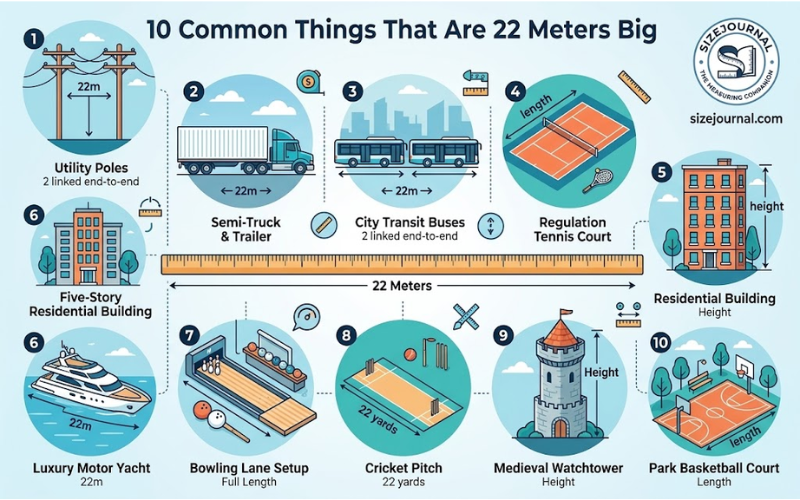
To give you a quick mental ruler, 22 meters converts to precisely 72.18 feet, or just over 24 yards. That is a noticeable span—long enough to park multiple full-sized sedans bumper-to-bumper and tall enough to clear the roof of a typical five-story residential apartment block. In this guide, we will explore ten distinct, highly visual everyday reference points that stretch or rise to right around 22 meters.
Quick Reference: 22 Meters at a Glance 📐
- In Feet: 72.18 feet
- In Yards: 24.06 yards
- In Inches: 866.14 inches
- In Centimeters: 2,200 centimeters
- Visual Baseline: Equivalent to walking about 28 average human paces in a straight line.
1. Two Standard Utility Poles Placed End-to-End ⚡
A fantastic way to visualize 22 meters while standing outside is to look up at local power line supports. Utility poles installed in neighborhood residential zones typically stand right around 11 meters (about 36 feet) tall above the ground surface.
If you were to take two of these standard wooden or concrete power poles and lay them flat on the ground end-to-end, their total combined length would measure exactly 22 meters. The next time you stroll down your street, take a look at a utility pole and mentally double its height along the pavement to see 22 meters stretched out in front of you.

2. A Commercial Semi-Truck and Trailer Rig 🚛
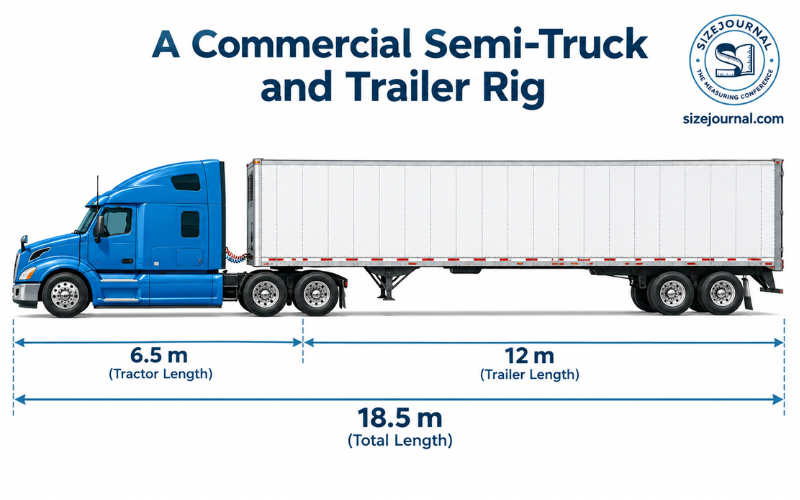
Logistics and freight shipping give us another great physical benchmark. A standard long-distance enclosed cargo trailer measures approximately 18 meters in length on its own.
When that trailer is hooked up to a standard day-cab or sleeper tractor unit (which adds roughly 4 meters from the front bumper to the rear connection hitch), the full front-to-back length of the entire vehicle reaches right around 22 meters. Walking along the side of a parked long-haul tractor-trailer gives you an immediate physical sense of this scale.
3. Two Urban Transit Buses Parked Back-to-Back 🚌
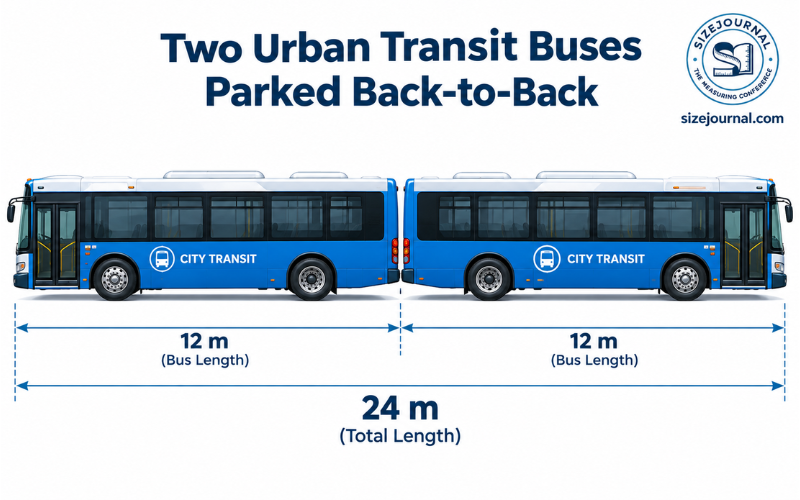
Public transportation systems offer a reliable way to gauge spatial distances in cities. Standard single-unit municipal transit buses, as well as iconic urban double-decker models, usually measure between 10.5 and 11 meters from bumper to bumper.
If a city bus driver parks two of these standard transit vehicles end-to-end at a station terminal, the combined bumper-to-bumper line measures roughly 22 meters. Walking past two full-sized buses parked in a straight row gives you a clear visual anchor for this distance.
4. The End-to-End Length of a Regulation Tennis Court 🎾
Sports facilities follow strict global standards, making them excellent tools for visual comparison. According to official guidelines, a regulation tennis court measures 78 feet from baseline to baseline, which equals 23.77 meters.
However, many community park courts, school practice grounds, and multi-sport play zones feature slightly condensed baseline boundaries or playing surfaces that settle right at a 22-meter total length. Standing at one baseline and gazing across the net toward the far end gives you a great spatial feel for this distance.

5. The Height of a Five-Story Residential Building 🏢
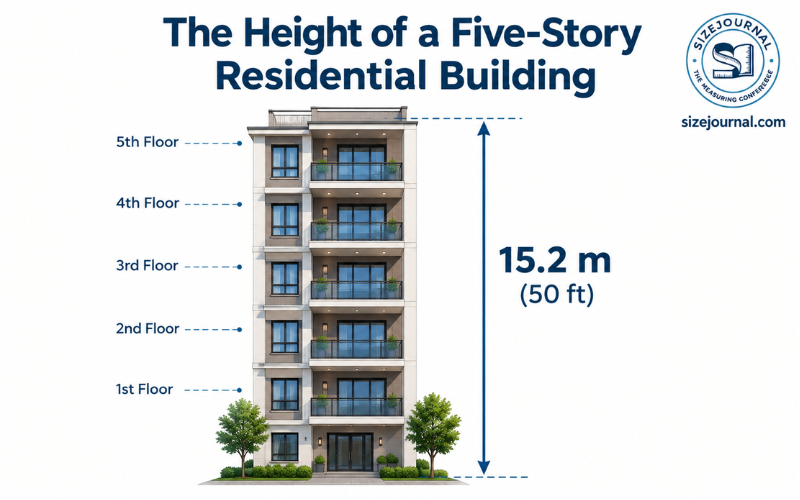
While horizontal spans are easy to picture along a road, 22 meters is equally impressive when measured vertically into the air. In urban architecture, the average floor-to-floor height for modern apartment complexes—including the ceiling clearance and the structural floor slab—is roughly 4.4 meters.
This means a standard mid-rise five-story residential building reaches an overall roof elevation of right around 22 meters. Looking up from the sidewalk to the top edge of a five-story building gives you an accurate sense of 22 meters in vertical height.
6. A Medium-Sized Luxury Motor Yacht 🛥️
Naval design relies on precise length measurements, and the luxury boat sector features prominent benchmarks. While giant superyachts span well over 50 meters, a very common tier for mid-sized luxury motor yachts falls in the 70 to 75-foot class.
This translates directly to a bow-to-stern length of roughly 22 meters. A vessel of this size comfortably houses multiple interior decks, guest cabins, and open lounges. Seeing a 22-meter motor yacht moored alongside a marina dock shows how substantial this length is on the water.

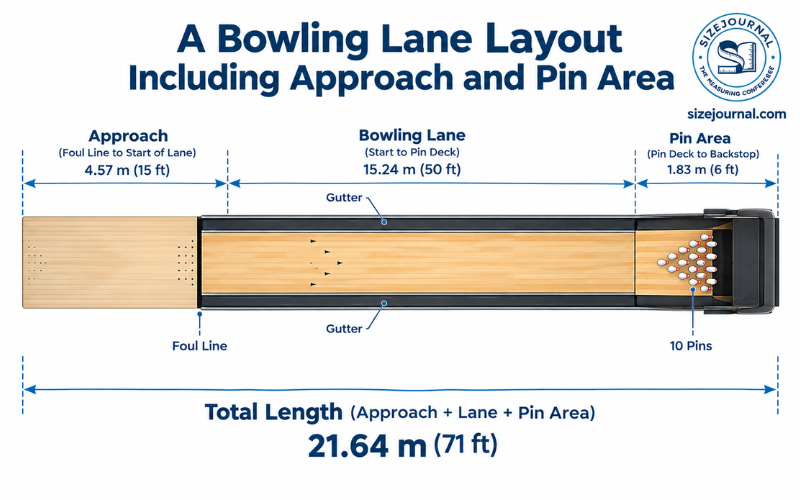
7. A Bowling Lane Layout Including Approach and Pin Area 🎳
Bowling centers use precise equipment dimensions. The distance from the foul line to the headpin on a regulation lane is exactly 60 feet (18.28 meters).
However, a complete bowling installation requires space beyond the wooden lane itself. When you factor in the approach area behind the foul line where players take their steps, along with the pin deck and pit area behind the pins, the total operational span from the back railing to the rear machinery reaches right at 22 meters.
8. A Historical Cricket Pitch (22 Yards) 🏏
One of the most famous historical sporting measurements is the central strip used in cricket. Standard rules mandate that the playing pitch between the two sets of wickets must measure exactly 22 yards.
Converting 22 yards to metric yields 20.12 meters. Although this is slightly short of 22 meters by less than two meters, it remains one of the closest and most recognized standard human references for this scale. Walking the length of a cricket pitch gets you extremely close to the full 22-meter distance.

9. Historical Stone Watchtowers and Keeps 🏰
Medieval military architecture frequently incorporated standard height parameters for defensive structures. Small stone watchtowers, village keeps, and castle outposts constructed across historical regions were routinely built to standard tactical heights of 22 meters.
These stone towers were engineered to provide clear views over surrounding terrain while remaining structurally stable against siege weapons. Standing at the base of a historical 22-meter stone watchtower offers a direct look at historical craftsmanship on this exact scale.

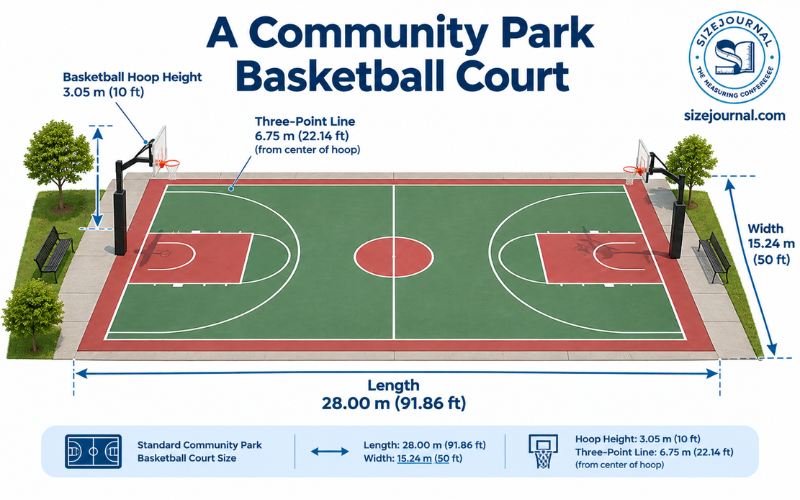
10. A Community Park Basketball Court 🏀
Basketball courts vary depending on whether they are built for professional leagues or local recreation. While professional arenas use larger dimensions, neighborhood park courts and outdoor recreational facilities often use more compact dimensions to fit available park spaces.
A standard community outdoor basketball court frequently spans approximately 22 meters from baseline to baseline. Walking from one hoop baseline down to the opposite basket on a neighborhood court provides a familiar, everyday frame of reference.
Object Comparison & Dimension Overview
To summarize how these various everyday objects, structures, and sports setups compare to a 22-meter baseline, review the reference table below:
| Object / System | Standard Measurement | Relationship to 22 Meters | Primary Spatial Orientation |
| Cricket Pitch | 20.12 meters (22 yards) | 1.88 meters shorter | Horizontal distance |
| Two Utility Poles | ~11 meters each | Exact match when combined | Vertical or horizontal |
| Semi-Truck & Trailer | ~22 meters total rig | Exact match for full vehicle | Horizontal distance |
| Tennis Court Baseline | ~22 to 23.77 meters | Matches typical court footprint | Horizontal distance |
| Five-Story Building | ~4.4 meters per floor | Matches overall roof height | Vertical height |
| Luxury Motor Yacht | ~72 feet bow to stern | Exact match for 72-ft vessel | Horizontal length |
| Full Bowling Setup | ~22 meters complete run | Exact match with approach area | Horizontal depth |
| Park Basketball Court | ~22 meters baseline length | Matches standard park layout | Horizontal length |
Related Posts
- 10 Common Things That Are 21 Meters Big: How Big Is 21 Meter?
- (how big is 20 meter) 10 Common Objects That Are 20 Meters Big
- 10 Common Things That Are 19 Meters Big
- 10 Common Things That Are 18 Meters Big
Frequently Asked Questions (FAQs) About 22 Meters
How many feet are in 22 meters?
There are approximately 72.18 feet in 22 meters. In everyday terms, that is just over 72 feet and 2 inches.
How long does it take to walk 22 meters?
For an adult walking at a comfortable, steady pace, covering 22 meters takes about 15 to 20 seconds, requiring roughly 27 to 30 average strides.
How does 22 meters compare to an Olympic swimming pool?
An Olympic-sized swimming pool measures 50 meters in length. Therefore, 22 meters is less than half the total length of an Olympic pool.
What is the easiest way to estimate 22 meters without a tape measure?
The simplest way is to count out 28 to 30 normal walking steps in a straight line, or visualize two full-sized city transit buses parked bumper-to-bumper.
Conclusion
Understanding physical measurements becomes much simpler when you move past abstract numbers and focus on tangible everyday objects. By comparing how big is 22 meter to familiar sights like two utility poles laid end-to-end, a long-haul semi-truck, a five-story building, or a local basketball court, you can easily picture this distance wherever you go. Whether you are visualizing vertical height or horizontal length, keeping these ten practical examples in mind gives you an instant mental reference point for 22 meters in any setting.
FOR MORE MEASUREMENTS VISIT: SIZE JOURNAL
1 thought on “10 Examples That Are 22 Meters Big”