

Have you ever wondered how big is 21 meter in real life? It can be difficult to understand a measurement when you only see it written in numbers. Twenty-one meters may not sound particularly large at first, but when you compare it with familiar objects such as buses, swimming pools, trees, buildings, and sports facilities, the measurement becomes much easier to understand.
A length of 21 meters is equal to 68.9 feet, approximately 22.97 yards, or 2,100 centimeters. It is longer than many city buses, close to the length of some swimming pools, and comparable to the height of a six- or seven-story building, depending on the height of each floor.
Understanding this measurement can be useful when planning a garden, estimating the dimensions of a building, comparing large objects, or simply satisfying your curiosity about everyday measurements. It can also help you visualize distances without needing a measuring tape.
In this article, we will explore 10 common things that are around 21 meters big and explain how each comparison helps you understand this length. Some examples are exact mathematical comparisons, while others are approximate because real-world dimensions vary by model, design, and location.
Quick Answer: How Big Is 21 Meter? 📏
21 meters is approximately 68.9 feet long. To put that into perspective, imagine placing seven small cars end to end, lining up two long city buses, or walking about 26 to 28 ordinary adult steps in a straight line.
Here are the basic measurements:
| Measurement | Equivalent |
|---|---|
| Meters | 21 m |
| Feet | 68.90 ft |
| Yards | 22.97 yd |
| Inches | 826.77 in |
| Centimeters | 2,100 cm |
| Millimeters | 21,000 mm |
| Kilometers | 0.021 km |
A few simple facts make this measurement easier to remember:
- A 21-meter length is just under 70 feet.
- It is approximately the length of four and a half standard tennis courts placed end to end.
- It is roughly the combined length of several passenger vehicles.
- If an object is 21 meters tall, it could be comparable to a medium-sized building.
- If you walk at a comfortable pace, covering 21 meters may take around 15–20 seconds.
Remember that 21 meters describes length, height, or distance, not area. A garden measuring 21 meters long could be narrow or wide, while a structure standing 21 meters tall would have a very different appearance.
1. Three Standard Intermodal Shipping Containers 📦
Three standard intermodal shipping containers placed end to end provide a practical way to understand a distance close to 21 meters.
A typical standard shipping container is about 20 feet long, equivalent to approximately 6.1 meters. When three of these containers are placed in a straight line, their combined length is approximately 18.3 meters.
That is shorter than 21 meters, but the comparison provides a useful starting point. An additional 2.7 meters would bring the total to approximately 21 meters.
How does the comparison work?
- One standard container: approximately 6.1 meters long.
- Two containers: approximately 12.2 meters long.
- Three containers: approximately 18.3 meters long.
- Three containers plus another 2.7 meters: approximately 21 meters.
A 40-foot shipping container is different, measuring approximately 12.2 meters long. Two of those containers placed end to end would reach about 24.4 meters, which is longer than 21 meters.
Where is this comparison useful?
Shipping containers are used at ports, warehouses, construction sites, factories, and storage facilities. If you have ever seen a row of containers at a shipping terminal, imagining three standard containers and a little extra space can help you estimate a distance of 21 meters.
The comparison is particularly useful when estimating storage layouts, temporary site facilities, or the length of a rectangular outdoor space.

2. A Large City Bus 🚌
A large city bus is another familiar way to visualize how big 21 meters is.
Many conventional single-deck city buses measure approximately 10–12 meters long. Articulated buses, which have a flexible joint connecting two passenger sections, are often around 18 meters long, although some models are longer.
A 21-meter distance is therefore comparable to a long articulated bus with several additional meters of space.
Comparing 21 meters with bus lengths
Consider these approximate examples:
- A 10-meter city bus is less than half the length of 21 meters.
- A 12-meter bus would fit into the distance once, with 9 meters remaining.
- An 18-meter articulated bus would leave approximately 3 meters remaining.
- Two conventional 10-meter buses would measure about 20 meters combined.
Two 10-meter buses placed end to end would come very close to 21 meters, leaving a difference of only 1 meter.
Actual bus lengths vary according to passenger capacity, manufacturer, and vehicle design, so these figures should be treated as general comparisons rather than specifications for every bus.
Why is this a useful example?
Buses are easy to recognize, and many people have stood beside one or watched one turn at an intersection. Thinking of two large buses parked bumper to bumper gives you a much more concrete sense of a 21-meter distance than simply reading the number.
It is also useful for estimating driveway lengths, parking arrangements, loading areas, and road space.

3. A Tennis Court Placed Lengthwise Several Times 🎾
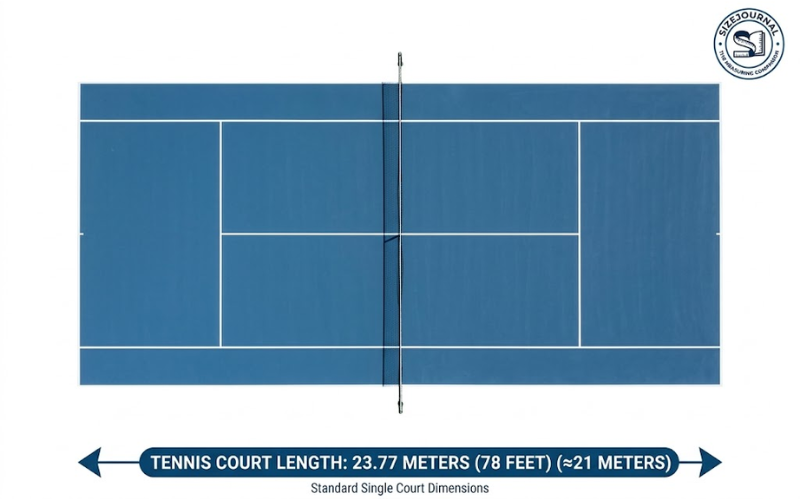
A tennis court is a useful reference because its dimensions are standardized for regulation play.
A standard tennis court measures 23.77 meters from baseline to baseline. That means 21 meters is slightly shorter than the full playing length of a regulation court.
The difference is only 2.77 meters, making a tennis court one of the closest familiar sporting comparisons for this measurement.
How close is 21 meters to a tennis court?
The calculation is straightforward:
- Regulation court length: 23.77 meters.
- Length being compared: 21 meters.
- Difference: 2.77 meters.
In percentage terms, 21 meters is approximately 88% of the length of a regulation tennis court.
Imagine standing at one baseline and walking toward the opposite baseline. You would cover 21 meters before reaching the far end, leaving less than 3 meters to go.
What about the width of a tennis court?
The width of a regulation court is approximately 8.23 meters for singles and 10.97 meters for doubles. A 21-meter distance is almost twice the doubles-court width.
This gives you two ways to understand the measurement: it is slightly shorter than the court’s full length and nearly twice its doubles width.
Where can this comparison help?
This example is useful when visualizing sports facilities, school playgrounds, recreational spaces, and outdoor areas. Tennis courts also offer a convenient reference because their official playing dimensions remain consistent, even though the surrounding fencing and walkways may differ.
4. A Seven-Story Building 🏢
A height of 21 meters can be comparable to a building with approximately six or seven stories.
However, the exact number of floors depends on ceiling heights, structural elements, roof design, and whether the building has commercial or residential floors.
For a simple estimate, assume each story measures 3 meters from one floor level to the next.
Calculating the building height
At approximately 3 meters per story:
Under this simplified assumption, a seven-story building would reach 21 meters.
In real buildings, residential stories may have different heights, while commercial buildings can have taller ground floors. A roof parapet, rooftop equipment, or architectural feature can also increase the total height.
How does 21 meters look vertically?
Imagine standing at street level and looking up at a building approximately 21 meters tall. It would be noticeably taller than a typical two-story house and could dominate the view in a low-rise neighborhood.
A building of this height may have a substantial presence without being considered a skyscraper.
Why is this comparison important?
This example is helpful when estimating building heights, evaluating the appearance of trees near structures, or understanding the vertical scale of urban development.
It also highlights an important distinction: a 21-meter-long object stretches across the ground, while a 21-meter-tall object rises upward. The measurement is identical, but the visual experience is different.

5. A Swimming Pool Measuring 21 Meters Long 🏊
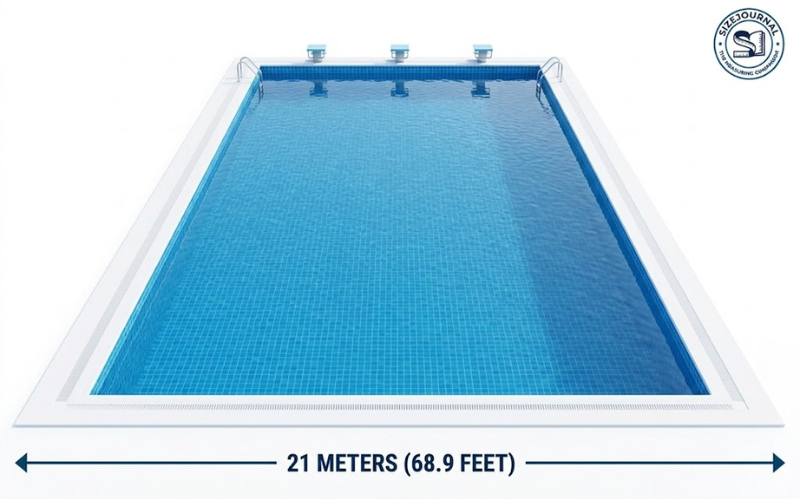
Swimming pools are often designed around familiar lengths, making them a useful reference for understanding 21 meters.
Many residential and recreational pools are shorter than 21 meters, while competitive swimming facilities frequently use 25-meter or 50-meter pool lengths. A 21-meter pool would be slightly shorter than a common 25-meter short-course pool.
Comparing pool lengths
A 21-meter pool would measure:
- 4 meters shorter than a 25-meter pool.
- 29 meters shorter than a 50-meter pool.
- Approximately 42% of the length of a 50-meter pool.
If you swim from one end of a 21-meter pool to the other, you cover 21 meters in a single length. Swimming back to the starting end would bring the total distance to 42 meters.
A pool’s length does not tell you its width or depth. Those dimensions can vary considerably depending on whether the pool is designed for recreation, exercise, lessons, or competition.
Can you recognize 21 meters in a swimming facility?
Yes. If you have visited a pool with marked lane distances, you can use those markings as a reference. A 21-meter length is long enough to allow several strokes before reaching the opposite end, yet noticeably shorter than a full 50-meter Olympic-size pool.
This comparison is particularly useful for home swimming pool planning, fitness facilities, and recreational property design.
6. Seven Passenger Cars Parked End to End 🚗
Passenger cars offer one of the easiest ways to visualize a long distance because their approximate dimensions are familiar.
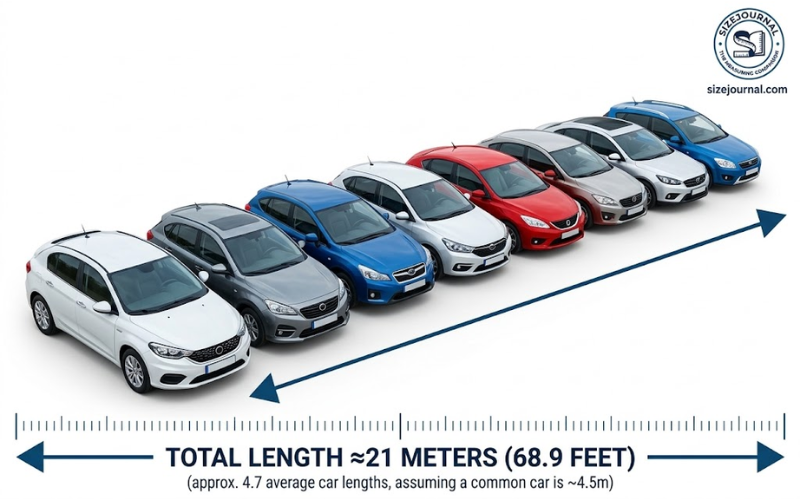
Many everyday passenger cars are around 4–5 meters long. If we use a representative length of 4.5 meters, seven cars placed bumper to bumper would measure approximately 31.5 meters, which is longer than 21 meters.
For a closer comparison, four and a half cars measuring 4.5 meters each would total approximately 20.25 meters.
How many cars make 21 meters?
Using a car length of 4.5 meters:
[
21 \div 4.5 \approx 4.67
]
Therefore, 21 meters is roughly the length of four and two-thirds average-sized passenger cars.
If you use smaller cars measuring 4 meters, a little over five cars would be needed. Larger vehicles would reduce the number required.
What does this look like in a parking area?
Imagine several cars lined up closely, with each vehicle touching the next bumper. The row would extend a substantial distance across a driveway or parking area.
Keep in mind that a real parking arrangement includes gaps between vehicles, and cars vary in length. Five cars measuring 4.5 meters each would occupy 22.5 meters before allowing for any gaps.
Why use cars as a reference?
This comparison helps when estimating driveway dimensions, garage layouts, parking spaces, and the length of a private road. It is also an easy mental calculation: roughly five ordinary cars placed end to end give you a distance close to 21 meters.
7. A Small Commercial Airplane’s Wingspan ✈️
An airplane’s wingspan is the distance from one wingtip to the other. Some smaller aircraft have wingspans that are close to 21 meters, although the exact figure varies substantially by aircraft model.
For example, certain light utility aircraft and smaller regional or specialized aircraft can have wingspans in the general range of 15–25 meters.
A wingspan of 21 meters means the aircraft’s wings extend 21 meters across from tip to tip. The fuselage length may be shorter or longer than the wingspan, depending on the design.
Understanding the wingspan
Think of the aircraft viewed from above:
- The left wing extends outward from the fuselage.
- The right wing extends in the opposite direction.
- The total tip-to-tip distance could measure approximately 21 meters.
This is a horizontal measurement, not the aircraft’s height. It is also not the same as the length of the airplane from its nose to its tail.
How does this comparison help?
Airplane dimensions are useful when thinking about airport hangars, aircraft storage, runway-side facilities, and the amount of space needed to move an aircraft safely on the ground.
The comparison is approximate because aircraft designs differ. A large commercial passenger aircraft can have a wingspan far greater than 21 meters, while many small private aircraft have considerably narrower wings.
If you have ever seen an aircraft parked on an apron, imagining a 21-meter distance between its wingtips provides a helpful sense of scale.

8. A Mature Tree’s Height or Canopy Spread 🌳
Trees are another useful natural reference because both their height and the width of their canopies can be substantial.
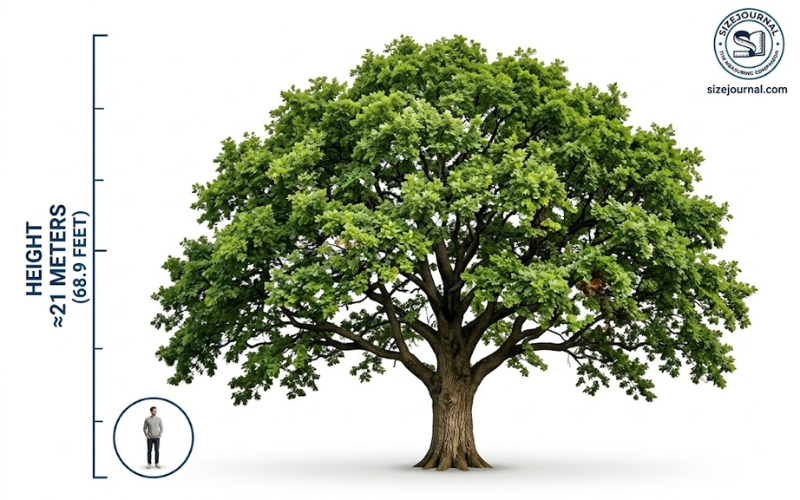
Some mature trees can reach heights of around 21 meters, while others remain much shorter. Similarly, certain broad-canopied trees can spread their branches across a width approaching 21 meters, depending on the species, age, growing conditions, and available space.
Understanding a 21-meter-tall tree
A tree that reaches 21 meters would stand approximately as tall as the simplified seven-story building described earlier.
However, tree height is not the same as canopy width. A tall, narrow tree may have a relatively small spread, while a shorter tree can have a wide, spreading crown.
For a rough visual comparison, imagine a tree whose trunk rises from the ground and whose upper branches reach the height of a low-rise building.
What does a 21-meter canopy spread mean?
If a tree has a canopy spread of 21 meters, the crown’s widest horizontal extent is approximately 21 meters across.
That does not necessarily mean the branches form a perfect circle. A tree’s crown may be irregular, elongated, or asymmetrical.
For a circular canopy with a diameter of 21 meters, the radius would be 10.5 meters. This means the crown could extend roughly 10.5 meters from its center in every direction.
Why is this comparison useful?
Tree dimensions matter when planning landscaping, placing buildings near mature trees, designing gardens, and estimating shade coverage.
A canopy this wide can influence how much sunlight reaches a lawn, patio, or nearby garden. It may also affect decisions about paths, overhead structures, and available outdoor space.
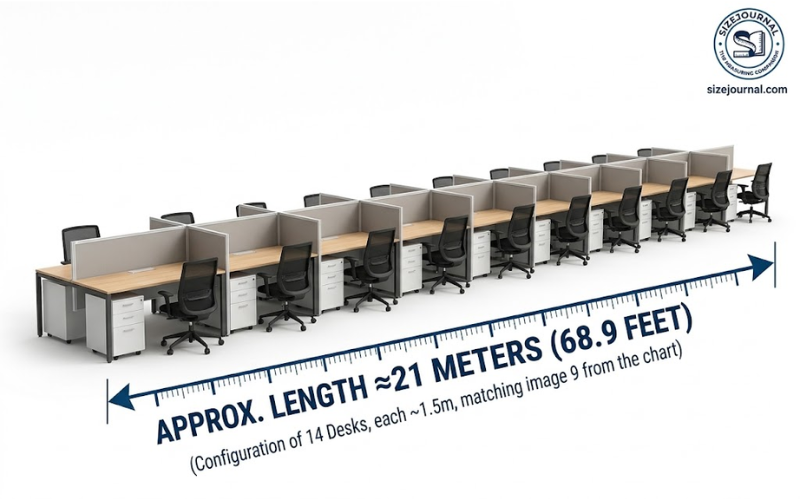
9. A Row of Seven Standard Office Desks 🪑
Office furniture offers another everyday comparison, particularly when planning rooms, workplaces, and commercial interiors.
Many standard office desks are approximately 1.2–1.8 meters wide, depending on their intended use. If you line up seven desks measuring 1.5 meters across, the total width would be 10.5 meters.
That is only half of 21 meters.
To reach a length of 21 meters using desks that are 1.5 meters wide, you would need 14 desks placed edge to edge.
Calculating the desk comparison
Using a desk width of 1.5 meters:
[
21 \div 1.5 = 14
]
Fourteen desks placed side by side would span 21 meters, assuming no gaps between them.
For desks measuring 1.2 meters wide, you would need 17.5 desk widths. With desks measuring 1.8 meters wide, you would need approximately 11.7 desk widths.
These are mathematical comparisons rather than recommended office layouts. In a real workplace, desks usually need space for chairs, walkways, power connections, and access to doors.
Where does this comparison help?
A 21-meter length can be useful when considering open-plan offices, classrooms, conference spaces, and coworking facilities.
It can also help you estimate the size of a room before measuring it accurately. If a space can accommodate a long line of 14 desks, each 1.5 meters wide, its available length may be around 21 meters.
10. A Large Garden or Backyard Length 🌿
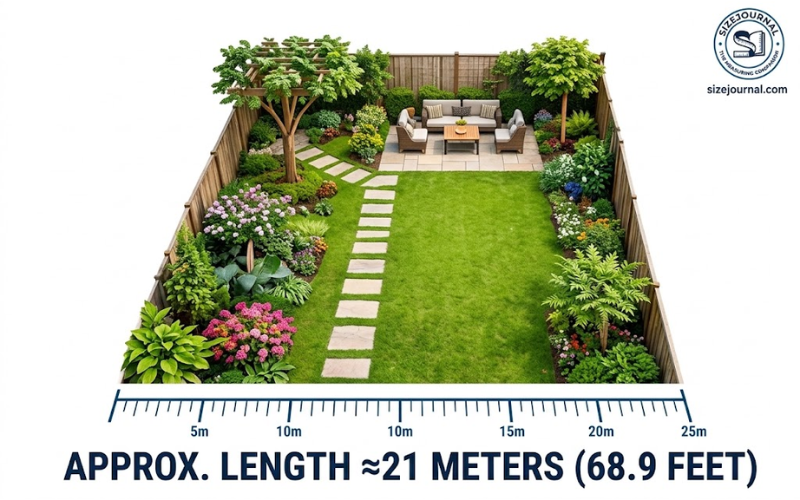
A garden measuring 21 meters from one end to the other is a realistic example of this distance in everyday life.
Unlike some of the other comparisons, a garden can have almost any width. A narrow garden might measure 21 meters long and 4 meters wide, while a larger backyard could have a similar length and a width of 12 meters or more.
What can fit into a 21-meter garden?
Depending on its shape and layout, a garden of this length could accommodate several features, such as:
- A lawn with a walking path.
- A small patio near the house.
- Flower beds or vegetable-growing areas.
- A seating area beneath a pergola.
- Trees and shrubs positioned along the boundaries.
These features depend on the available width, local building requirements, drainage, sunlight, and access.
How long would it take to walk across?
At a walking speed of approximately 4–5 kilometers per hour, walking 21 meters would take around 15–19 seconds.
This is only an estimate. A person’s pace, mobility, footwear, and the condition of the ground can affect the time.
You can also pace out the distance yourself. An adult’s walking step might cover approximately 0.7–0.8 meters, so 21 meters could require around 26–30 steps.
Why is a garden a good reference?
Most people have walked through a backyard, garden, or outdoor recreational space. Thinking of a garden that takes several dozen ordinary steps to cross makes 21 meters feel less abstract.
It is also a practical comparison for landscaping, fencing, garden paths, and outdoor renovation projects.
Interesting Facts About 21 Meters 📐
The same measurement can look completely different depending on the object being measured. A 21-meter wingspan occupies horizontal space, while a 21-meter tree rises vertically and a 21-meter swimming pool stretches along the ground.
Here are a few additional facts to make the measurement easier to remember.
21 meters is nearly 70 feet
One meter is approximately 3.28084 feet. Multiplying 21 by this conversion factor gives approximately 68.9 feet.
This is why 21 meters is often easier to visualize when compared with buildings, vehicles, or spaces whose dimensions are described in feet.
It is longer than a basketball court
A regulation basketball court is generally 28 meters long under FIBA rules, while NBA courts are approximately 28.65 meters long. A distance of 21 meters is shorter than either court, but still covers a large portion of its playing length.
It is less than half the length of an Olympic swimming pool
An Olympic-size swimming pool is 50 meters long. A 21-meter distance is 42% of that length, making it somewhat less than half.
Walking 21 meters takes only a short time
At a typical walking pace, you could cover 21 meters in less than half a minute. The actual time depends on your pace and surroundings.
A 21-meter height can make a structure stand out
A building around 21 meters tall may be prominent in an area dominated by single-story houses. The same height may appear modest in a city center with much taller buildings.
Biowiki Table: 21 Meters at a Glance
The following biowiki-style reference table summarizes the 10 comparisons and the dimensions that make each example useful.
| Object or structure | Approximate dimension | How it compares with 21 meters |
|---|---|---|
| Three standard shipping containers | 18.3 m combined | 2.7 m shorter |
| Long articulated city bus | Around 18 m | About 3 m shorter |
| Regulation tennis court | 23.77 m long | 2.77 m longer |
| Seven-story building | Around 21 m tall at 3 m per story | Approximately equal in height |
| Recreational swimming pool | 21 m long in this example | Equal in length |
| Passenger cars | 4.5 m each | About 4.7 cars |
| Small aircraft wingspan | Varies by model | Some aircraft approach 21 m |
| Mature tree | Height or canopy spread varies | Some reach approximately 21 m |
| Office desks | 1.5 m each | 14 desk widths |
| Garden or backyard | 21 m long in this example | Equal in length |
Note: The table uses a mixture of standard dimensions, representative examples, and hypothetical measurements. It is intended to help visualize scale, not to provide engineering specifications for every object.
How to Measure 21 Meters Accurately
If you need to mark out a real distance of 21 meters, a visual comparison is helpful, but an actual measurement is more reliable.
Use a measuring tape
A long measuring tape can help you measure shorter sections and combine them. For a 21-meter distance, make sure the tape remains straight and that you account for each section without overlapping or leaving gaps.
Use a laser distance meter
A laser distance meter can be useful indoors or outdoors when you need to measure a long, unobstructed line. Check the instrument’s operating range and follow the manufacturer’s instructions.
Measure using a known reference
If you are estimating a distance without measuring equipment, use a reference with known dimensions, such as a regulation tennis court or a vehicle whose length you can verify.
This method is suitable for rough estimates, but it should not replace professional measurements for construction, property boundaries, or safety-critical work.
Calculate the distance from a map or plan
For a building layout, garden, or other planned space, use the dimensions shown on an accurate drawing. Confirm the scale before measuring the drawing itself, and remember that a printed plan may have been resized.
Related Posts
- (how big is 20 meter) 10 Common Objects That Are 20 Meters Big
- 10 Common Things That Are 18 Meters Big
- 10 Common Things That Are 17 Meter Big
- 10 Common Things That Are 16 Meters Big
Frequently Asked Questions About How Big Is 21 Meter?
1. How big is 21 meter in feet?
Twenty-one meters is approximately 68.9 feet. For a quick mental estimate, you can think of it as just under 70 feet.
2. How many yards are in 21 meters?
Twenty-one meters is approximately 22.97 yards, which is just under 23 yards.
3. Is 21 meters considered long?
Yes, 21 meters is a substantial length for many everyday objects and outdoor spaces. It is longer than a conventional city bus, close to the length of a 21-meter swimming pool, and nearly 70 feet from end to end.
Whether it feels long depends on the object being measured and the surrounding environment.
4. How many cars fit into 21 meters?
If each car measures approximately 4.5 meters long, about 4.7 cars would fit end to end within 21 meters. In practical terms, four full cars would occupy 18 meters, leaving about 3 meters.
The exact number changes with vehicle size and the gaps between parked cars.
5. Is 21 meters the same as 21 square meters?
No. Meters measure length, while square meters measure area.
A length of 21 meters describes a straight-line distance. An area of 21 square meters describes the amount of surface within a boundary, such as the floor area of a room.
For example, a rectangular space measuring 7 meters by 3 meters has an area of 21 square meters, but neither side is 21 meters long.
6. How tall is a 21-meter building?
A 21-meter building could have approximately seven stories if each story is around 3 meters high. The actual number of floors depends on architectural design and floor-to-floor heights.
Conclusion
Understanding how big is 21 meter becomes much easier when you compare it with familiar objects rather than relying on the number alone. At approximately 68.9 feet, 21 meters is a substantial distance that can be visualized using buses, shipping containers, tennis courts, swimming pools, passenger cars, trees, and garden spaces.
Some comparisons are close approximations, while others depend on the specific dimensions of an object. A seven-story building, for example, could reach approximately 21 meters under a simplified floor-height assumption, while a regulation tennis court is slightly longer than that distance.
The most useful approach is to remember that 21 meters is just under 70 feet and then connect that figure to objects you regularly see. Whether you are planning a garden, estimating a building’s height, or simply curious about measurements, these comparisons provide a practical starting point for understanding the size of 21 meters.
FOR MORE MEASUREMENTS VISIT: SIZE JOURNAL
5 thoughts on “10 Common Things That Are 21 Meters Big: How Big Is 21 Meter?”