

Have you ever wondered how big is 17 meter and what that length actually looks like in everyday life? Seventeen meters can be difficult to visualize because it is much longer than most household objects, yet it is still a distance we can encounter in buildings, vehicles, sports equipment, boats, trees, and other large structures.
To understand how big is 17 meter, it helps to compare it with familiar things. Seventeen meters is equal to 1,700 centimeters, about 55.77 feet, or approximately 18.59 yards. In feet and inches, it is about 55 feet 9.29 inches.
That means 17 meters is roughly the length of a large vehicle, a substantial sailboat, or the height of a multi-story structure. It is also considerably longer than a typical family car and much greater than the length of an ordinary room.
In this guide, we will look at 10 familiar examples that can help you understand the size of 17 meters more easily. 📏
Quick Answer: How Big Is 17 Meter?
17 meters is a length of 17 meters, which equals:
- 1,700 centimeters
- 17,000 millimeters
- 55.77 feet
- 55 feet 9.29 inches
- 18.59 yards
- 0.017 kilometers
- 669.29 inches
The conversion to feet comes from multiplying 17 by 3.28084, while the conversion to yards gives approximately 18.59 yards.
A simple way to remember it is that 17 meters is just under 56 feet long.
If you stood at one end of a 17-meter line and walked straight to the other end, you would travel a little more than half the length of a standard 30-meter swimming pool.
Understanding 17 Meters in Everyday Life
Numbers can sometimes make a measurement feel abstract. Saying something is “17 meters long” does not immediately tell most people how large it is.
For comparison, a typical adult is nowhere near 2 meters tall. You would need several adults standing head-to-foot to reach 17 meters. Similarly, an ordinary passenger car is only a few meters long, meaning several cars placed end-to-end would be needed to approach 17 meters.
This is why familiar objects are useful when answering how big is 17 meter.
A 17-meter measurement can represent length, width, height, or distance. The examples below are approximate comparisons rather than claims that every example has exactly the same measurement.
1. A Large Sailboat or Yacht ⛵
A large sailing yacht can be an excellent way to understand what 17 meters looks like.
Many cruising and sailing boats are designed in the range of roughly 15 to 20 meters, depending on the model and type. A boat around 17 meters long would be a substantial vessel, with enough length for multiple cabins, living areas, storage, and outdoor spaces.
If you stood beside a 17-meter yacht, its length would stretch considerably farther than a typical car. Looking from the bow toward the stern, the distance would be similar to walking across a large section of a parking area.
A 17-meter boat can also provide a useful visual comparison because its measurement is horizontal. Unlike a building, you can imagine the entire 17 meters extending directly in front of you.
How the comparison works
Imagine marking a point on the ground at the front of a boat and another point 17 meters away. The distance between those two points represents the boat’s approximate length.
This is one of the easiest ways to understand how big is 17 meter because you can imagine walking along the entire length.
Why it is useful
A boat is particularly useful for visualizing 17 meters because:
- It has a long, narrow shape.
- The entire measurement is visible from end to end.
- It is substantially longer than an ordinary automobile.
- It gives a clear horizontal comparison.
So, when someone asks how big 17 meters is, thinking about a large yacht around this size can provide a practical mental image. ⛵

2. A Large Motorhome or Coach 🚌
Another useful comparison is a large motorhome, coach, or specialized long passenger vehicle.
Not every bus or motorhome reaches 17 meters, but some larger vehicles and combinations can approach or exceed this length. Depending on the design and whether a trailer is included, a long recreational or passenger vehicle can occupy a significant portion of a 17-meter space.
Imagine parking a large vehicle at one end of a 17-meter-long area. The vehicle could stretch across most of that distance.
This comparison is particularly useful because most people have seen buses or coaches in real life. Even if the exact vehicle is not 17 meters, its familiar appearance makes it easier to understand the scale.
17 meters compared with a car
A normal passenger car is only a few meters long. Therefore, placing several cars nose-to-tail can produce a combined length approaching 17 meters.
For example, if four cars averaged about 4.25 meters each, their combined length would be approximately 17 meters.
That does not mean every car is 4.25 meters long. Vehicle dimensions vary considerably. The comparison simply demonstrates the scale.
🚗 17 meters is long enough to accommodate several ordinary cars in a straight line.

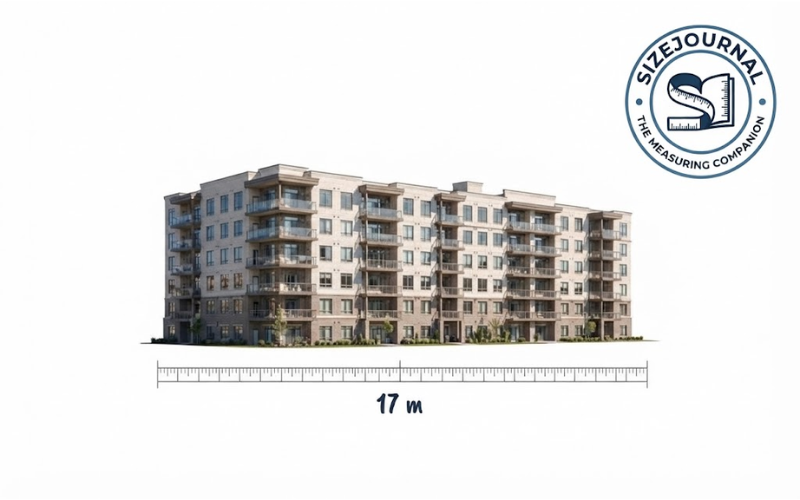
3. A Five-Story Building 🏢
Seventeen meters can also be used as a rough height comparison for a multi-story building.
A building’s exact height depends on ceiling height, floor thickness, roof construction, and architectural design. However, a five-story structure can reach a height in the general neighborhood of 17 meters.
This makes a multi-story building one of the more interesting ways to understand the measurement because it changes the perspective from horizontal distance to vertical height.
If you stand at street level and look toward a structure approximately 17 meters high, the top can appear surprisingly far above you.
Why building height varies
There is no universal height for a five-story building. One building may have shorter floors, while another may have taller ceilings or additional structural space.
For that reason, 17 meters should be treated as a comparison rather than a fixed height for every five-story building.
Still, imagining a building around five stories tall gives you a strong sense of the scale.
A simple visual comparison
Think about:
- Ground floor
- Second floor
- Third floor
- Fourth floor
- Fifth floor
Depending on the design, the total vertical height can approach the 17-meter mark.
🏢 This shows that 17 meters is not just a long distance—it can also represent a surprisingly tall vertical space.
4. A Large Tree 🌳
Some mature trees can reach heights around 17 meters.
Tree height varies enormously by species, climate, age, soil conditions, and growing environment. Some trees remain relatively short, while others grow many times taller than 17 meters.
A tree around 17 meters tall would be noticeably larger than the trees commonly found in small residential yards.
Standing beneath such a tree gives a useful perspective. If you look from the base toward the top, you would be viewing a vertical distance comparable to 17 meters.
Why trees make a good comparison
Trees are familiar objects, so they help turn a measurement into something visual.
A tree around 17 meters tall might:
- Rise several stories above the ground.
- Extend well above many nearby buildings.
- Have a broad canopy depending on the species.
- Look much taller when viewed from directly underneath.
🌳 The next time you see a large mature tree, consider whether its height might be somewhere around 17 meters.

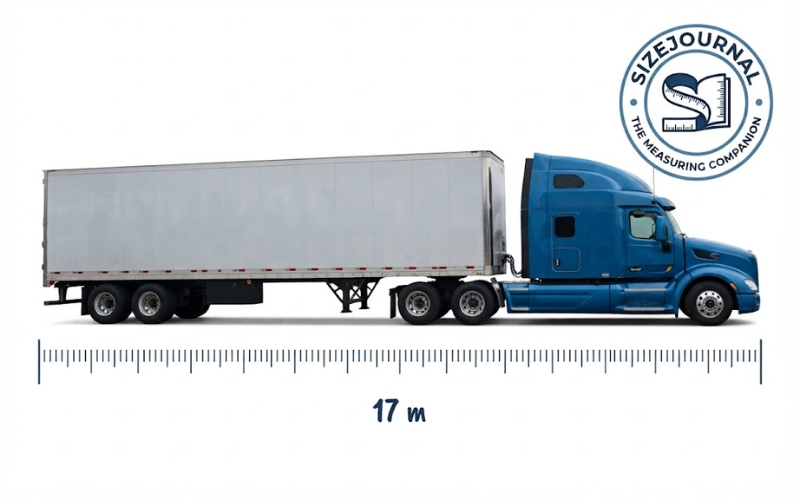
5. A Long Semi-Truck and Trailer Combination 🚛
Large commercial trucks provide another helpful comparison.
Truck dimensions differ by country, vehicle type, trailer configuration, and regulations. A tractor-trailer combination can be around the 17-meter range in some configurations, making it a useful approximate comparison.
A long truck also makes it easy to imagine 17 meters because you can see the full vehicle stretching from the front of the cab to the rear of the trailer.
Why trucks help explain 17 meters
A truck and trailer combination is much longer than a regular passenger vehicle. It occupies a large amount of road space and is easy to recognize.
Imagine standing beside a long truck and walking from its front bumper toward the back of the trailer. Depending on its configuration, that journey could bring you close to 17 meters.
🚛 This is particularly useful when thinking about 17 meters as a horizontal length.
It also demonstrates why measurements matter in transportation. Vehicle length affects parking spaces, turning areas, loading zones, road design, and maneuverability.
6. A Large Fishing or Commercial Boat 🎣
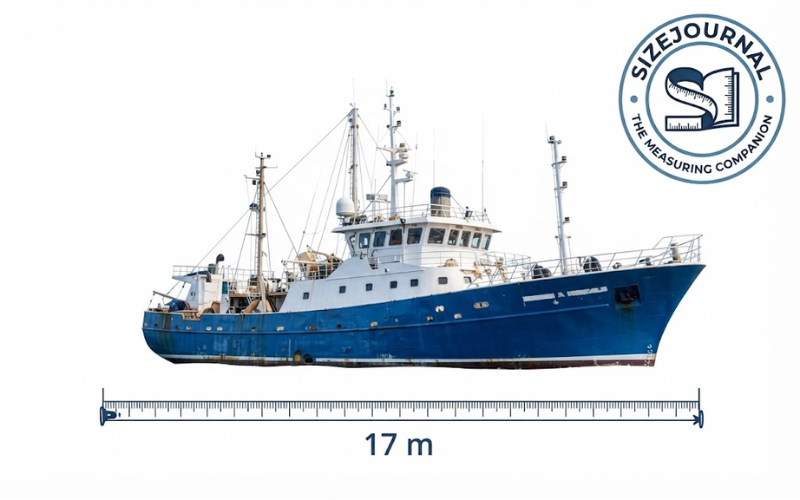
Commercial fishing boats and other working vessels can also provide a useful 17-meter comparison.
A boat around this length can be considerably larger than the small recreational boats commonly seen on lakes or near beaches. It may have space for equipment, storage, sleeping areas, machinery, and working decks depending on its purpose.
Unlike a compact speedboat, a vessel around 17 meters has enough length to feel like a substantial working platform.
What makes this comparison interesting?
The 17-meter measurement is easy to imagine because boats have clearly defined ends.
If you place one marker at the bow and another at the stern, the distance between them could be close to 17 meters.
The same length can feel very different depending on the shape of the object. A narrow boat 17 meters long may not appear as massive as a building that is 17 meters tall, even though the measurement is identical.
🎣 This is a good reminder that length and overall size are not the same thing. A 17-meter object can be narrow, wide, tall, or relatively compact.
7. A Large Inflatable or Event Structure 🎪
Temporary event structures can also reach dimensions close to 17 meters.
Large inflatable attractions, exhibition structures, temporary shelters, and event installations are sometimes designed with dimensions measured in the tens of meters.
For example, a large inflatable attraction could stretch approximately 17 meters from one end to another. Depending on its design, it might also have considerable width and height.
This comparison is useful because it shows how 17 meters can be experienced in recreational spaces.
At an event, you might see a structure that looks enormous from ground level but is still only a fraction of the length of a large sports field.
17 meters across an event space
A 17-meter structure could occupy:
- A large section of an exhibition area.
- A significant portion of an outdoor event space.
- Several parking spaces placed end-to-end.
- A noticeable section of a recreation area.
🎪 This gives another practical answer to the question, how big is 17 meter?
It is large enough to become a major feature in many temporary installations.

8. A Long Swimming Pool or Pool Section 🏊
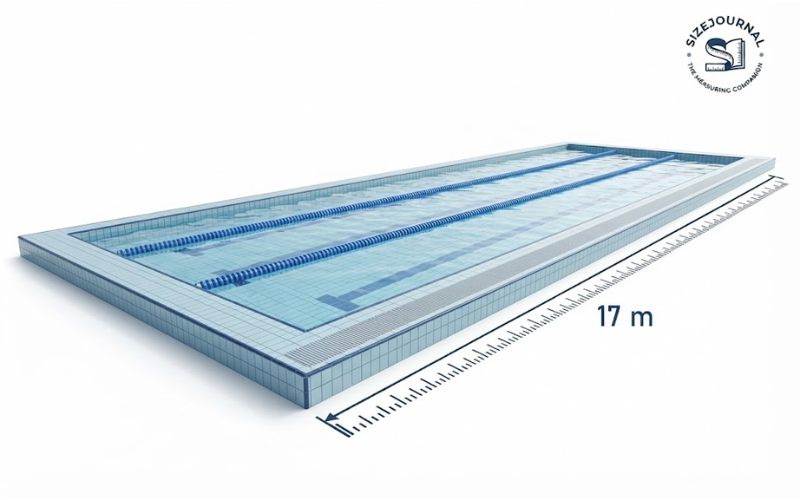
Swimming pools come in many sizes, so not every pool is 17 meters long. However, a 17-meter pool or pool section is a useful measurement comparison.
Imagine a rectangular pool that measures 17 meters from one end to the other. Swimming across it would require covering the same distance as 17 meters.
For recreational swimming, a pool of this length would provide a substantial distance for each lap.
Comparing it with a standard swimming pool
An Olympic-size swimming pool is 50 meters long, so 17 meters is approximately one-third of that length.
This gives you another useful reference point.
If you divide 50 meters into three roughly equal sections, each section would be about 16.67 meters. Therefore, 17 meters is just slightly longer than one-third of an Olympic pool.
🏊 This makes 17 meters easier to visualize for anyone familiar with swimming pools.
Why this comparison works
Unlike a height comparison, a swimming pool lets you imagine the distance at ground level. You can mentally see yourself starting at one end and moving toward the opposite end.
That makes it a practical way to understand how big is 17 meter.
9. A Long Row of Four Average Cars 🚗🚗🚗🚗
Sometimes the best comparison does not involve one huge object.
Instead, think about several familiar objects placed end-to-end.
If four passenger cars averaged around 4.25 meters each, they would create a combined length of approximately 17 meters.
Of course, cars are available in many sizes. A small city car may be considerably shorter, while a large SUV can be longer. Therefore, four cars are only an approximate visualization.
Still, this comparison makes the measurement easy to imagine.
Imagine four cars in a straight line
Picture the following:
Car 1 → Car 2 → Car 3 → Car 4
If their combined lengths total approximately 17 meters, the line from the front of the first car to the back of the fourth car gives you a visual representation of 17 meters.
This is particularly useful because most people have a rough idea of how long a car is.
🚗 Four average-sized cars arranged bumper-to-bumper can give you a surprisingly good sense of the scale.

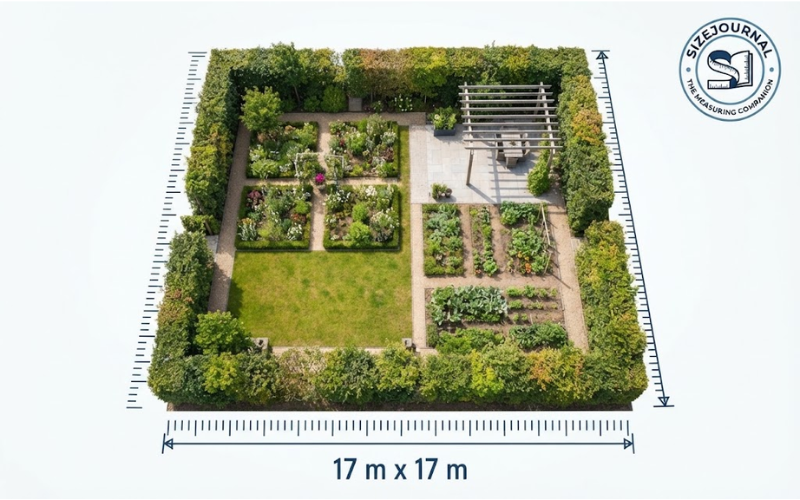
10. A Large Garden or Outdoor Space 📐
Our final comparison is not a single object but a familiar type of space.
A garden, courtyard, driveway, or outdoor recreation area can easily have one dimension measuring approximately 17 meters.
For example, an outdoor rectangular area could measure 17 meters from one end to the other while being much narrower in the other direction.
Imagine walking from one end of a 17-meter garden to the opposite end. At an ordinary walking pace, it would take only a short amount of time, but the distance would still be much greater than a typical room.
Why open spaces are useful comparisons
An open space lets you understand 17 meters without having to imagine a giant object.
You can simply think of a straight line:
Start → 5 m → 10 m → 15 m → 17 m → Finish
This makes it easier to estimate distances in real-world settings.
📐 A 17-meter outdoor space is long enough to feel substantial while still being manageable for walking and measuring.
How Big Is 17 Meter Compared With Common Measurements?
Understanding nearby measurements can make 17 meters even easier to visualize.
Here are several useful conversions:
| Measurement | Equivalent to 17 meters |
|---|---|
| Centimeters | 1,700 cm |
| Millimeters | 17,000 mm |
| Feet | 55.77 ft |
| Feet and inches | 55 ft 9.29 in |
| Yards | 18.59 yd |
| Inches | 669.29 in |
| Kilometers | 0.017 km |
The feet and yard values are calculated using fixed conversion relationships. Seventeen meters equals approximately 55.77 feet and 18.59 yards.
17 Meters Compared With 10 Meters
Ten meters is considerably shorter than 17 m.
The difference is:
17 m − 10 m = 7 m
So 17 m is 7 m longer than 10 m.
If you have ever seen a 10-meter measurement, adding another 7 m gives you the full 17-meter distance.
This is useful for estimating measurements because 10 meters is a relatively easy benchmark.
17 Meters Compared With 15 Meters
Fifteen meters is closer to 17 m.
The difference is only:
17 m − 15 m = 2 m
That means 17 m is about 13.3% longer than 15 m.
If you can visualize 15 m, simply adding another 2 m gives you 17 m.
This can be useful when estimating the length of boats, outdoor spaces, buildings, or vehicles.
17 Meters Compared With 20 Meters
Twenty meters is 3 meters longer than 17 m.
The difference is:
20 m − 17 m = 3 m
Therefore, 17 meters is 85% of 20 meters.
Another simple way to visualize it is to imagine a 20-meter line and remove the final 3 meters. What remains is exactly 17 m.
How Many Steps Is 17 Meters?
The number of steps required to cover 17 meters depends on a person’s stride length.
A person with a longer stride may cover the distance in fewer steps, while a person with a shorter stride may need more.
For example, using a hypothetical average stride of 0.75 meters:
17 ÷ 0.75 ≈ 22.7 steps
So 17 meters could be roughly 23 walking steps for someone with a 75-centimeter stride.
This is only an estimate because walking styles differ.
If you want to use your own steps as a measuring tool, walk naturally over a known distance first and calculate your average stride length.
How to Measure 17 Meters Accurately 📏
If you need to mark an actual 17-meter distance, the easiest option is a measuring tape designed for long distances.
For larger spaces, you can also use a surveyor’s measuring wheel or another suitable distance-measuring device.
Using a measuring tape
- Place the beginning of the tape at your starting point.
- Extend it in a straight line.
- Stop at the 17-meter mark.
- Mark the endpoint.
- Check the measurement again if accuracy is important.
Using smaller measurements
If you only have a shorter measuring tape, measure the distance in sections.
For example:
Together:
5 + 5 + 5 + 2 = 17 meters
This method can help when measuring gardens, rooms, driveways, or outdoor areas.
Why 17 Meters Can Look Different Depending on the Object
One important point is that 17 meters describes length or distance, not total size.
A 17-meter-long rope is very different from a 17-meter-tall building.
A narrow 17-meter boat may look relatively small from certain angles, while a 17-meter-high structure can appear enormous.
The surrounding environment also changes how large something appears.
For example, a 17-meter object may look huge in a small residential area but less impressive when placed beside a large stadium or industrial building.
This is why using multiple comparisons is helpful when answering how big is 17 meter.
Interesting Facts About 17 Meters
Here are a few quick facts that make the measurement easier to remember:
- 📏 17 m equals 1,700 centimeters.
- 👣 It can be roughly 23 steps for a person with a 0.75-meter stride.
- 📐 It equals about 55.77 feet.
- 📐 It equals about 18.59 yards.
- 🚗 Four cars with an average length of about 4.25 m each would total approximately 17 m.
- 🏊 17 m is slightly more than one-third of a 50-meter Olympic swimming pool.
- 🏢 A five-story building can provide a rough visual reference for a 17-meter height, although actual building heights vary.
- 🌳 Some mature trees can reach around this height.
- ⛵ Large boats can have lengths in the neighborhood of 17 m.
- 🚛 Long commercial vehicle combinations can provide another useful horizontal comparison.
A Simple Way to Visualize 17 Meters
If you are still wondering how big is 17 meter, try this simple mental exercise.
Start with a standard door. A typical door is roughly 2 meters tall. Now imagine placing several door heights one above another.
Eight door heights would give you approximately:
8 × 2 = 16 meters
Add another meter, and you reach:
17 meters.
This is not a precise architectural comparison, because doors come in different sizes, but it provides an easy mental scale.
For horizontal distance, imagine walking across an open area for about 17 m. It is long enough to require several dozen normal steps but short enough to cross comfortably in a few seconds.
Why Knowing 17 Meters Is Useful
Knowing how large 17 m is can be useful in many situations.
Architects and builders use measurements like this when planning structures and spaces. Engineers need accurate dimensions when designing equipment and transportation systems. Event organizers may need to know whether a large structure will fit into a venue.
Even outside professional work, understanding measurements can help when:
- Planning a garden.
- Measuring a driveway.
- Choosing a boat.
- Estimating the size of an outdoor area.
- Understanding building dimensions.
- Comparing vehicle lengths.
- Planning an event space.
- Visualizing distances on a map.
- Reading construction plans.
A measurement becomes much easier to understand when you can connect it to something familiar.
BioWiki Table
| Detail | Information |
|---|---|
| Measurement | 17 meters |
| Symbol | 17 m |
| Centimeters | 1,700 cm |
| Millimeters | 17,000 mm |
| Feet | Approximately 55.77 ft |
| Feet and inches | Approximately 55 ft 9.29 in |
| Yards | Approximately 18.59 yd |
| Inches | Approximately 669.29 in |
| Kilometers | 0.017 km |
| Type | Length / distance |
| Metric system | Yes |
| Common visual references | Large boats, long vehicles, mature trees, multi-story buildings, outdoor spaces |
Related Posts
- 10 Common Things That Are 16 Meters Big
- 10 Common Things That Are 15 Meters Big
- 10 Common Things That Are 14 Meters Big
- 10 Common Things That Are 13 Meters Big
Frequently Asked Questions
How big is 17 meter?
17 m is a length of 1,700 centimeters, or approximately 55.77 feet and 18.59 yards. It is a substantial distance that can be visualized using several cars, a large boat, a long vehicle, or a multi-story building.
How many feet are in 17 meters?
There are approximately 55.77 feet in 17 meters. More precisely, 17 m is about 55 feet and 9.29 inches.
How many yards are in 17 meters?
17 m equals approximately 18.59 yards. The conversion uses the relationship of 1 meter being approximately 1.093613 yards.
Final Thoughts
So, how big is 17 meter? Seventeen meters is a surprisingly substantial measurement. It equals 1,700 centimeters, about 55.77 feet, or approximately 18.59 yards.
The easiest way to understand it is through familiar comparisons. A large yacht or commercial boat can provide a useful 17-meter length reference. A long truck can demonstrate the horizontal distance, while a multi-story building or mature tree can help you imagine the same measurement vertically. Even four appropriately sized cars placed end-to-end can give you a practical idea of the distance.
The next time you come across a measurement of 17 m, think of a distance stretching roughly 56 feet from one point to another. Once you connect the number with familiar objects and spaces, 17 meters becomes much easier to visualize and understand.
FOR MORE MEASUREMENTS VISIT: SIZE JOURNAL
6 thoughts on “10 Common Things That Are 17 Meter Big”