Have you ever wondered how long 18 meters really is? Measurements can be difficult to understand when they appear only as numbers. However, comparing them with familiar objects, sports facilities, buildings, and natural features makes them much easier to visualize.
Eighteen meters is a substantial distance that equals approximately 59.06 feet. It is longer than most cars, much longer than a typical room, and comparable to the length of several large objects used in everyday life.
If you are researching how big is 18 meter, this guide will help you understand the measurement through ten real-world comparisons. You will also learn how to convert 18 meters into other units, estimate this distance without measuring equipment, and recognize where this measurement is useful.
Quick Answer: How Big Is 18 Meter?
18 meters equals 1,800 centimeters, 18,000 millimeters, approximately 59.06 feet, and 19.69 yards.
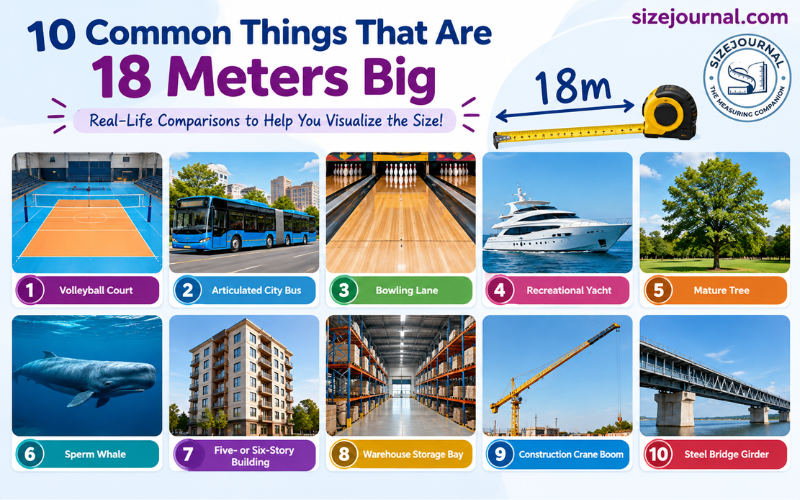
A standard indoor volleyball court is exactly 18 meters long, making it one of the easiest ways to visualize this measurement.
Here are some quick comparisons:
- 🏐 A standard indoor volleyball court is 18 meters long.
- 🎳 A regulation ten-pin bowling lane is approximately 18.29 meters long.
- 🚌 Some articulated city buses measure around 18 meters.
- 🌳 A tall mature tree may reach approximately 18 meters in height.
- 🏢 A building with five or six stories may be around 18 meters tall.
- ⛵ Some recreational yachts measure approximately 18 meters from bow to stern.
These examples do not all have exactly the same dimensions. Some are close estimates, while others provide a reliable reference for the measurement.
1. A Standard Indoor Volleyball Court 🏐
A standard indoor volleyball court is one of the most reliable examples of an object measuring 18 meters long. According to established volleyball court dimensions, the playing area measures 18 meters in length and 9 meters in width.
This means that the distance from one end line to the opposite end line is exactly 18 meters. If you have ever watched an indoor volleyball match, you have already seen a space that can help you understand this measurement.
The court is divided into two equal halves by a net. Each half is 9 meters long, so placing the two halves together gives you the complete 18-meter length.
For a simple comparison, imagine standing at one end of the court and walking straight toward the opposite end. Once you reach the other side, you will have traveled 18 meters.
The court also demonstrates how length and width work together. Although it measures 18 meters from end to end, its width is only 9 meters. Therefore, the playing area is twice as long as it is wide.
Why it is a useful comparison: Volleyball courts are found in schools, sports centers, colleges, and recreational facilities. Their standardized dimensions make them more dependable than objects whose sizes vary from one model to another.
If someone asks you how big 18 meters is, you can simply explain that it is the length of a standard indoor volleyball court.

2. An Articulated City Bus 🚌
An articulated city bus is another useful example of something approximately 18 meters long. Unlike a conventional bus, this vehicle has two connected sections joined by a flexible middle joint.
These buses are commonly used in busy urban areas because they can carry more passengers than many standard buses. Their connected design allows the vehicle to bend while navigating turns.
Some full-size articulated buses are approximately 18 meters long, although the exact dimensions depend on the manufacturer and model.
To understand this length, imagine four passenger cars parked in a straight line. If each car measures around 4.5 meters, their combined length would be approximately 18 meters.
An articulated bus can therefore occupy a similar amount of horizontal space to four average-sized cars placed bumper to bumper.
Of course, not every bus measures 18 meters. Standard single-section buses are usually shorter, so the articulated design is the more appropriate comparison.
Why it is a useful comparison: Long city buses are familiar sights in many urban areas. Their size helps explain why large vehicles require additional turning space, longer stopping distances, and carefully planned bus stops.
The next time you see an articulated bus, think of its overall length as a practical example of a distance close to 59 feet.

3. A Regulation Ten-Pin Bowling Lane 🎳
A regulation ten-pin bowling lane is remarkably close to 18 meters long. The official playing distance from the foul line to the center of the headpin is 60 feet, equivalent to approximately 18.29 meters.
That makes the bowling lane about 29 centimeters longer than 18 meters.
This is a helpful comparison because a bowling lane has a clearly defined starting point and endpoint. Unlike an irregularly shaped room or a curved natural feature, it extends in a straight line.
When you stand near the foul line and look toward the pins, you can see almost the entire distance in front of you. The long, narrow surface also makes the measurement easier to appreciate.
However, remember that the bowling lane’s playing distance is not the same as the total length of the bowling facility. The approach area, pin deck, and machinery occupy additional space.
For everyday estimation, the difference between 18 meters and 18.29 meters is relatively small. Both measurements provide a similar visual impression.
Why it is a useful comparison: Bowling lanes are excellent examples for understanding sports measurements. They also show that an object does not have to measure exactly 18 meters to help you recognize the approximate distance.
If you regularly visit a bowling center, use the lane as a reference the next time you need to estimate a long, straight measurement.

4. A Large Recreational Yacht ⛵
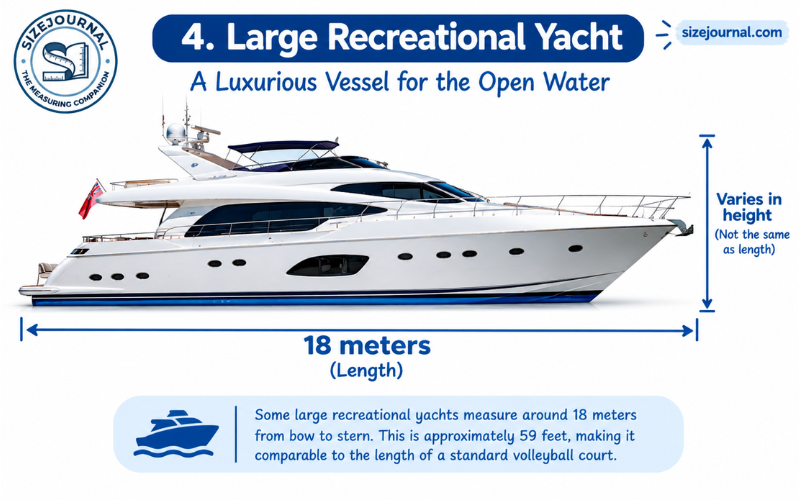
Some recreational yachts measure approximately 18 meters from the front of the vessel to the back. This makes them useful examples of long objects that people may encounter at marinas and coastal destinations.
An 18-meter yacht is approximately 59 feet long. Depending on its design, it may include several cabins, a kitchen area, indoor seating, outdoor decks, and storage compartments.
Yachts of this size can have very different appearances. Some are designed for comfortable family cruising, while others emphasize speed, entertaining guests, or extended trips on the water.
A vessel’s length is measured from its front end, known as the bow, to its rear end, known as the stern. This measurement should not be confused with the yacht’s height above the water or its width across the hull.
Imagine a yacht moored alongside a dock. Its length could be comparable to that of a standard volleyball court, although its curved body and wider shape make it look quite different.
Not every yacht is 18 meters long. Smaller recreational boats can measure only a few meters, while larger luxury yachts may extend well beyond this length.
Why it is a useful comparison: Yachts demonstrate how 18 meters applies to marine transportation. They are particularly helpful for understanding vessel dimensions, marina layouts, and the space needed to accommodate larger boats.
5. A Mature Tree 🌳
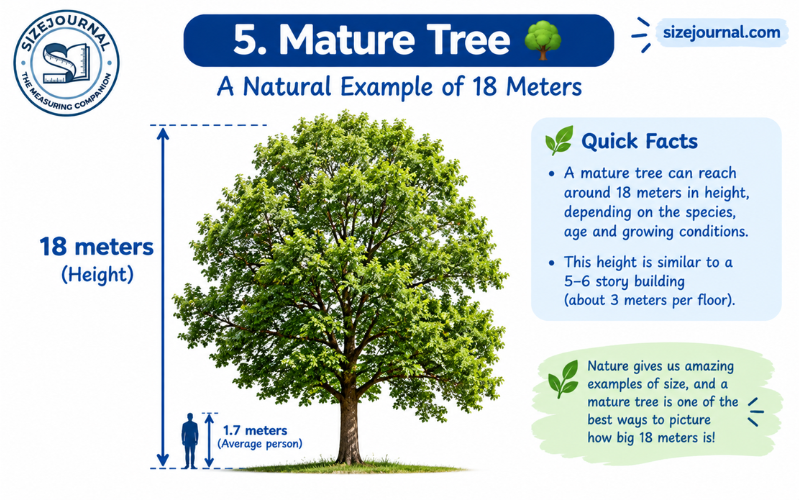
A mature tree can reach approximately 18 meters in height, depending on its species, age, and growing conditions.
Many trees in parks, gardens, and wooded areas grow tall enough to provide a useful reference for understanding vertical measurements. However, some species remain much shorter, while others can grow considerably taller.
To visualize 18 meters, imagine standing beneath a mature tree and looking toward the top of its crown. The distance from the ground to the highest point could be close to 18 meters.
Another way to understand this height is to compare it with a building. If each story is approximately 3 meters high, six stories would add up to 18 meters.
A tree reaching this height could therefore rise to a similar elevation as a six-story structure. The actual comparison depends on the building’s floor heights and roof design.
Trees are especially useful because they demonstrate height rather than horizontal length. Although an 18-meter tree and an 18-meter bus share the same measurement, one extends upward while the other extends along the ground.
Why it is a useful comparison: Trees provide a natural reference for estimating the height of poles, buildings, and other structures. They are also useful for school projects involving nature, forestry, and environmental studies.
Remember that tree height varies considerably. Use 18 meters as an example of a possible mature tree height, not a measurement that applies to every tree.
6. A Male Sperm Whale 🐋
A large male sperm whale can approach or exceed 18 meters in length, making it an impressive example from the natural world.
Sperm whales are the largest toothed whales. They are recognizable by their enormous heads, relatively narrow lower jaws, and ability to dive to great depths while searching for food.
Adult males generally grow larger than females, and their lengths vary according to age and individual growth. Consequently, 18 meters is a useful reference rather than a fixed size for the species.
Imagine a sperm whale swimming through the ocean with its body extending over nearly 59 feet. Its overall length would be comparable to that of a long city bus or a standard volleyball court.
The measurement runs from the front of the whale’s head to the end of its tail. It does not describe how tall the animal is or how wide its body appears when viewed from above.
This comparison is particularly interesting because it shows that a living animal can reach a length similar to that of a large man-made vehicle.
Why it is a useful comparison: Large marine animals help explain measurements in wildlife education and science. They provide memorable examples of how length varies across the natural world.
It is important to remember that not every sperm whale reaches 18 meters. Individual size varies, and some whales grow beyond this measurement.

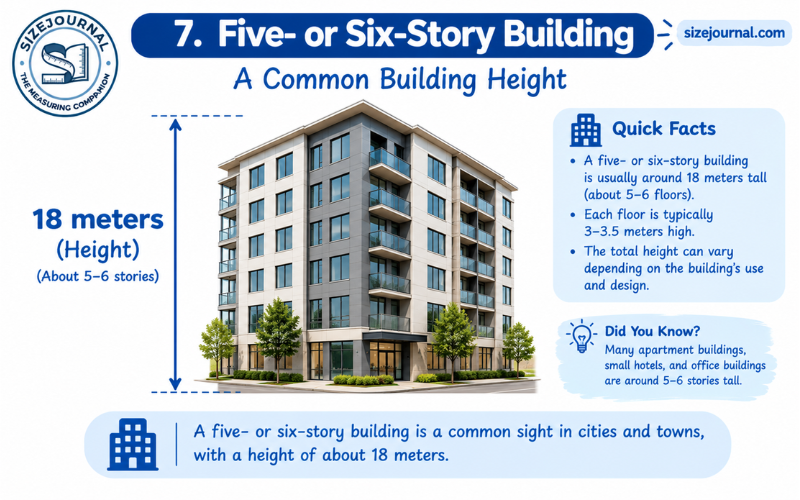
7. A Five- or Six-Story Building 🏢
A building measuring approximately 18 meters tall might have five or six stories, depending on its architectural design.
For a simple example, suppose each story has a floor-to-floor height of 3 meters. Six stories would give a total height of 18 meters.
This calculation provides an easy way to understand the measurement without needing to see a building with an exact height of 18 meters.
However, actual buildings vary. Residential apartments, offices, hotels, and commercial structures may have different ceiling heights and structural arrangements. Ground floors can also be taller than the upper stories.
For example, a commercial building with a high entrance level may reach 18 meters with fewer floors than a residential building with shorter stories.
You should also consider whether the stated height includes the roof, rooftop equipment, or decorative architectural features.
Why it is a useful comparison: Buildings are familiar landmarks that make vertical measurements easier to visualize. If you live near a mid-rise apartment block, its approximate height may help you understand what 18 meters looks like.
This comparison is also helpful when learning about architecture, construction, and urban planning.
8. A Warehouse Storage Bay 🏭
A large warehouse may contain storage bays or open sections extending approximately 18 meters in length.
Warehouses are designed for storing goods, moving materials, operating machinery, and accommodating vehicles. Their layouts depend on the size of the products being stored and the type of work carried out inside.
An 18-meter section might be used for a row of storage racks, a production area, or a clear aisle connecting different parts of a facility.
Imagine walking from one end of an 18-meter warehouse section to the other. You would cover approximately the same distance as the length of a standard volleyball court.
The warehouse might feel larger because its roof, walls, and equipment surround the space. Nevertheless, the actual horizontal distance remains the same.
It is important to note that warehouse layouts are not standardized around an 18-meter bay. Some buildings use shorter sections, while others have much wider spans between structural supports.
Why it is a useful comparison: Warehouses demonstrate how measurements are applied in industrial design. Understanding the length of a storage area can help when planning shelving, equipment placement, and movement through a commercial building.

9. A Construction Crane Boom 🏗️
A construction crane can provide an 18-meter comparison when a particular boom section or its overall boom length is approximately this size.
The boom is the long structural arm used to lift and move materials. Depending on the equipment, it may consist of several sections that extend or retract as required.
A boom measuring 18 meters would be approximately 59 feet long. That is a substantial component, particularly when viewed alongside workers, vehicles, and building materials at a construction site.
However, the length of a crane boom is not necessarily equal to its vertical reach. A boom positioned at an angle can extend upward while also reaching horizontally across the work area.
The dimensions of cranes vary considerably. Some smaller machines have shorter booms, while larger cranes can extend much farther than 18 meters.
For this reason, an 18-meter boom should be understood as an example of a possible component length rather than a standard dimension for all cranes.
Why it is a useful comparison: Crane booms demonstrate how long structural components are used in engineering and construction. They are especially relevant when learning about lifting equipment, building projects, and mechanical design.

10. A Steel Bridge Girder 🌉
A steel bridge girder measuring approximately 18 meters long provides another useful comparison.
Girders are major structural components that support loads in bridges and other structures. They transfer weight toward supporting elements such as piers, columns, and other parts of the bridge framework.
The length of a girder depends on the design of the bridge, the distance between supports, the materials selected, and the loads the structure must carry.
Some bridge projects use girders around 18 meters long, while others require substantially longer components.
To understand the measurement, imagine a straight steel beam extending across the full length of a volleyball court. Its length would cover the same distance, although the girder would have a completely different shape and purpose.
Large steel components can look particularly impressive when transported on trailers or placed beside construction machinery. Their size becomes easier to recognize when compared with people and familiar objects.

Comparison Table: 10 Things That Are Around 18 Meters Big
| Object | Approximate Measurement | Dimension |
|---|---|---|
| Indoor volleyball court | 18 m | Length |
| Articulated city bus | Around 18 m | Length |
| Ten-pin bowling lane | 18.29 m | Playing distance |
| Recreational yacht | Around 18 m | Length |
| Mature tree | Around 18 m | Height |
| Male sperm whale | May approach or exceed 18 m | Length |
| Five- or six-story building | Around 18 m | Height |
| Warehouse storage bay | Around 18 m in some designs | Length |
| Construction crane boom | Around 18 m in some configurations | Component length |
| Steel bridge girder | Around 18 m in some designs | Length |
These examples are approximate unless a standardized dimension is specified. The volleyball court provides an exact 18-meter reference, while the bowling lane is slightly longer.
Interesting Facts About 18 Meters 📏
It Is Almost 60 Feet Long
Eighteen meters is approximately 59.06 feet. For everyday estimates, you can round this to 59 feet or remember that it is just under 60 feet.
It Equals 1,800 Centimeters
To convert meters into centimeters, multiply the number of meters by 100.
18 × 100 = 1,800 centimeters.
This conversion is useful for school mathematics, measurement exercises, and comparisons involving smaller metric units.
It Equals 18,000 Millimeters
One meter contains 1,000 millimeters. Therefore, 18 meters contains 18,000 millimeters.
Although millimeters are useful for precise measurements, meters are generally more convenient when describing the length of a bus, a building, or a sports court.
It Is Just Under 20 Yards
Eighteen meters is approximately 19.69 yards. That makes it slightly shorter than 20 yards, providing another convenient way to remember the distance.
It Is 36% of an Olympic Swimming Pool’s Length
A standard long-course Olympic swimming pool measures 50 meters long.
To calculate how much of the pool 18 meters represents:
(18 ÷ 50) × 100 = 36%.
Therefore, 18 meters would cover a little more than one-third of the pool’s length.
How to Estimate 18 Meters Without a Measuring Tape
You can estimate an 18-meter distance by using familiar measurements and simple calculations. These methods are useful for general understanding, although they are not substitutes for accurate measuring equipment when precision is important.
Count Your Walking Steps
A walking step might cover approximately 0.75 meters, depending on your stride.
Divide 18 meters by 0.75 meters per step:
18 ÷ 0.75 = 24 steps.
Using this estimate, you would need around 24 steps to walk 18 meters. Your actual number may differ because people have different stride lengths.
Use Floor Tiles
Suppose you have square floor tiles measuring 50 centimeters along each side.
Convert the tile length into meters:
50 cm = 0.5 m.
Then divide 18 meters by 0.5 meters:
18 ÷ 0.5 = 36 tiles.
You would need 36 tiles placed edge to edge to cover 18 meters in a straight line.
Compare It With a Volleyball Court
A standard indoor volleyball court is exactly 18 meters long. If you have access to one, the distance between its end lines provides a convenient reference.
This is generally more reliable than estimating the length of an unfamiliar room or outdoor space.
Use a Building as a Height Reference
A building with six stories, each approximately 3 meters high, would have a floor-to-floor height totaling 18 meters.
Actual building heights vary, so this method provides only an estimate. For accurate measurements, consult building specifications or use an appropriate measuring instrument.
Where Is Knowing the Size of 18 Meters Useful?
Understanding this measurement can be helpful in many everyday and professional situations.
- Education: Students can use familiar objects to learn about metric conversions and estimation.
- Construction: Builders and engineers work with lengths when planning structural components and spaces.
- Transportation: Vehicle dimensions help people understand parking requirements and road layouts.
- Sports: Standard court dimensions provide accurate references for measuring playing areas.
- Property planning: Longer measurements can help with garden layouts, driveways, and outdoor projects.
- Wildlife education: Large animals provide memorable examples of length in the natural world.
The important thing is to choose a comparison that matches the dimension you want to understand. A tree is a helpful reference for height, while a bus or boat is more suitable for length.
BioWiki Table: 18 Meters at a Glance
| Measurement Detail | Information |
|---|---|
| Measurement | 18 meters |
| Standard symbol | 18 m |
| Feet | Approximately 59.06 ft |
| Inches | Approximately 708.66 in |
| Centimeters | 1,800 cm |
| Millimeters | 18,000 mm |
| Yards | Approximately 19.69 yd |
| Exact real-world comparison | Standard indoor volleyball court length |
| Near-exact sports comparison | Ten-pin bowling lane |
| Transportation comparison | Articulated city bus |
| Height comparison | A building around six stories tall |
| Common applications | Sports, construction, transportation, nature, and engineering |
Related Posts
- 10 Common Things That Are 17 Meter Big
- 10 Common Things That Are 16 Meters Big
- 10 Common Things That Are 15 Meters Big
- 10 Common Things That Are 14 Meters Big
Frequently Asked Questions (FAQs)
1. How big is 18 meter in feet?
Eighteen meters equals approximately 59.06 feet, or about 59 feet and 1 inch. It is slightly shorter than 60 feet.
2. What is something exactly 18 meters long?
A standard indoor volleyball court measures exactly 18 meters long and 9 meters wide. It is one of the most dependable real-world examples of this measurement.
3. Is 18 meters considered a long distance?
Eighteen meters is a considerable distance compared with household objects, furniture, and most passenger cars. However, it is relatively short compared with roads, athletic tracks, and large swimming pools.
Conclusion
Understanding how big is 18 meter becomes much easier when you connect the measurement with familiar objects and spaces. A standard volleyball court provides an exact reference, while an articulated bus, bowling lane, yacht, mature tree, and mid-rise building offer additional ways to visualize the distance.
Eighteen meters equals 1,800 centimeters, 18,000 millimeters, approximately 59.06 feet, and 19.69 yards. It is a useful measurement to recognize in sports, transportation, construction, and nature.
The next time you need to estimate this distance, remember a volleyball court or imagine a long city bus. These simple comparisons can help you understand 18 meters without relying on numbers alone.
FOR MORE MEASUREMENTS VISIT: SIZE JOURNAL
6 thoughts on “10 Common Things That Are 18 Meters Big”