
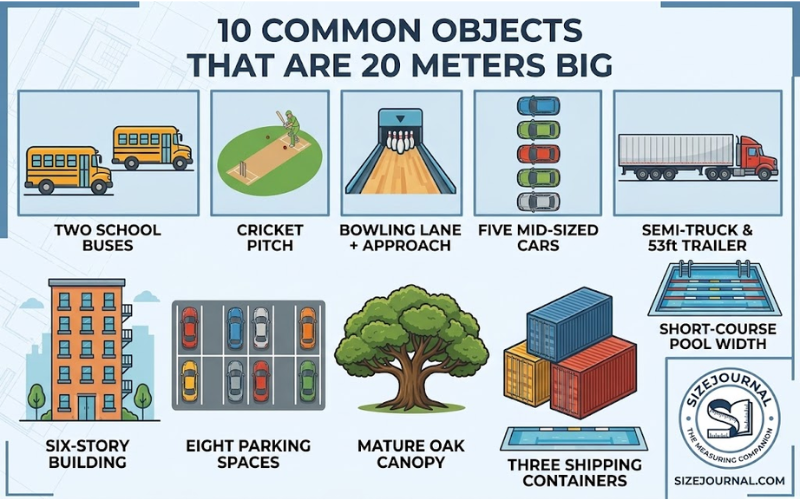
Quick Section: The 20-Meter Snapshot ⏱️
- Imperial Length: ~65.62 feet (65 feet and 7.4 inches)
- Yards: ~21.87 yards
- Centimeters: 2,000 cm
- Millimeters: 20,000 mm
- Walking Distance: Roughly 25 to 28 full strides for an average adult
- Instant Visual: Picture two standard yellow school buses lined up bumper-to-bumper 🚌🚌
Understanding the Scale of 20 Meters 📏
When people ask how big is 20 meter, the exact conversion—65.62 feet—does not always trigger a clear mental image. Math on paper is clean and precise, but human spatial awareness relies on touchpoints from everyday life.
Whether you are sizing up a garden lot, estimating ceiling heights, planning a landscaping project, or simply curious about measurements, 20 meters sits at a unique threshold. It is substantial enough to define structural heights and vehicular spans, yet small enough to fit within a neighborhood street block. Let’s look at ten distinct real-world objects and structures that span roughly 20 meters so you can easily spot this distance wherever you are.
1. Two Standard Yellow School Buses Parked End-to-End 🚌
A classic American full-size school bus measures right between 9.5 and 11 meters from its heavy front bumper to the rear emergency exit.
When you align two of these long yellow vehicles back-to-back along a street curb, the total nose-to-tail length reaches almost exactly 20 meters. Because school buses are large, boxy, and widely recognized, visualizing two of them parked in a straight row gives you both the linear distance and an idea of the massive bulk that 20 meters can encompass.

2. A Regulation Cricket Pitch Wicket-to-Wicket 🏏
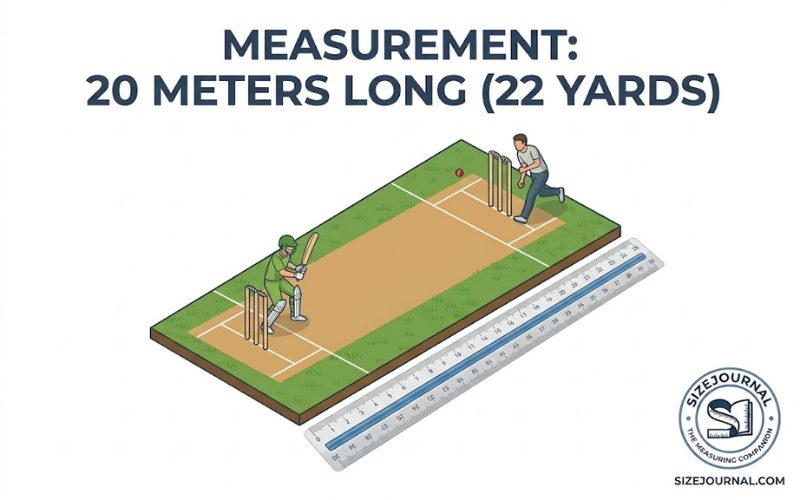
Sports provide some of the most reliable standardized measurements on the planet. If you follow cricket, the playing field holds a precise answer to how big is 20 meter.
The distance between the two sets of wickets on a regulation pitch is exactly 22 yards, which converts precisely to 20.12 meters. From the moment the bowler begins their delivery run up to the bowler’s crease down to the batsman holding their ground at the opposite end, the entire core action of the game unfolds over this specific 20-meter corridor.
3. A Full Bowling Lane with the Approach Area 🎳
If you visit a local bowling center, you are looking across a space tailored almost perfectly to this scale.
The bowling lane itself—measured from the foul line to the headpin—is 18.29 meters long (60 feet). When you add the required approach area where players take their steps before releasing the ball (typically around 4.5 feet or 1.37 meters), the entire active playing strip stretches out to nearly 20 meters end-to-end. Standing on the back edge of the wooden approach and looking toward the pins gives a direct view of this exact distance.

4. Five Compact or Mid-Sized Cars Parked in a Line 🚗
Automobiles are ideal tools for estimating distance on city streets or parking decks.
An average modern compact sedan measures around 4 to 4.5 meters long from bumper to bumper. If you park five of these vehicles tightly in a single row—or picture them lined up at a traffic light—their total combined length spans right around 20 meters. This handy visual makes it easy to walk down a street and measure off 20 meters simply by counting parked cars.

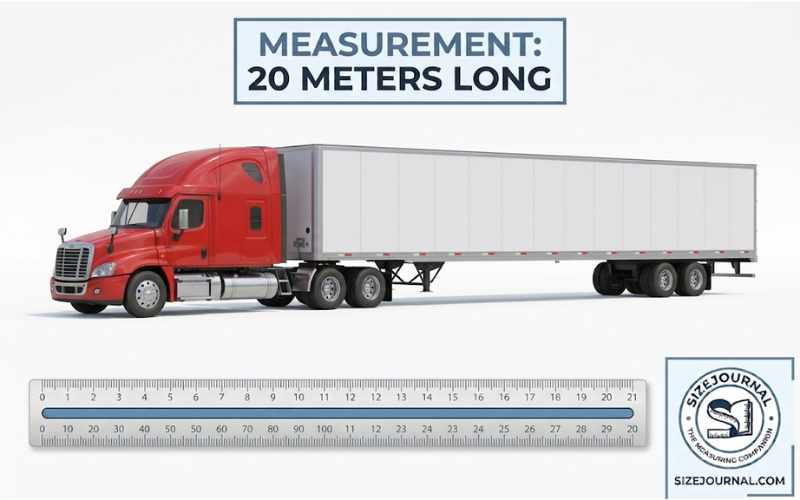
5. A Full Semi-Truck with a 53-Foot Cargo Trailer 🚛
Long-haul freight transport relies on standardized trailer sizes across highway networks worldwide.
A standard intermodal semi-trailer measures 53 feet in length (about 16.15 meters). When you hitch that massive box trailer to a modern sleeper-cab tractor unit, the full length of the truck combo lands between 19.5 and 21 meters. Seeing one of these commercial rigs cruising down the highway gives you an immediate appreciation for how impressive a 20-meter span looks on the road.
6. The Vertical Height of a Six-Story Residential Building 🏢
Looking at distance horizontally is only half the story; vertical height changes our perception of space completely.
In residential construction, a single story typically averages 3 to 3.3 meters high, accounting for floor slabs, ceiling clearance, and utility spaces. Stacking six floor levels creates an architectural height of approximately 20 meters. Standing on a sidewalk and looking up at the roofline of a standard six-story apartment complex shows you just how tall 20 meters feels when turned on its side.

7. A Row of Eight Standard Parking Bays Side-by-Side 🅿️
Commercial parking lots follow strict civil engineering layouts to ensure vehicles can park safely side-by-side.
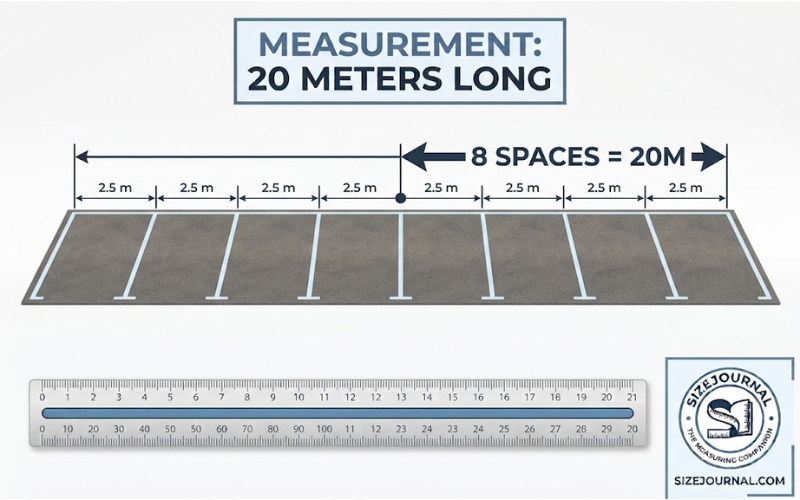
A standard angled or straight parking stall measures roughly 2.5 meters in width. If you walk along a row of empty spaces and count off eight consecutive stalls, the combined width spans exactly 20 meters. This horizontal grid pattern is a great reference point when you are standing outdoors in an open lot with no tape measure handy.
8. The Canopy Spread of a Mature Oak Tree 🌳
Nature offers plenty of organic structures that match this metric scale.
While young saplings remain modest, a mature White Oak or English Oak that has grown uninterrupted for decades often reaches a canopy spread of 18 to 22 meters across. The huge umbrella of branches creates a shaded circle on the ground whose entire diameter sits right at the 20-meter mark, proving that natural growth frequently mirrors large structural dimensions.

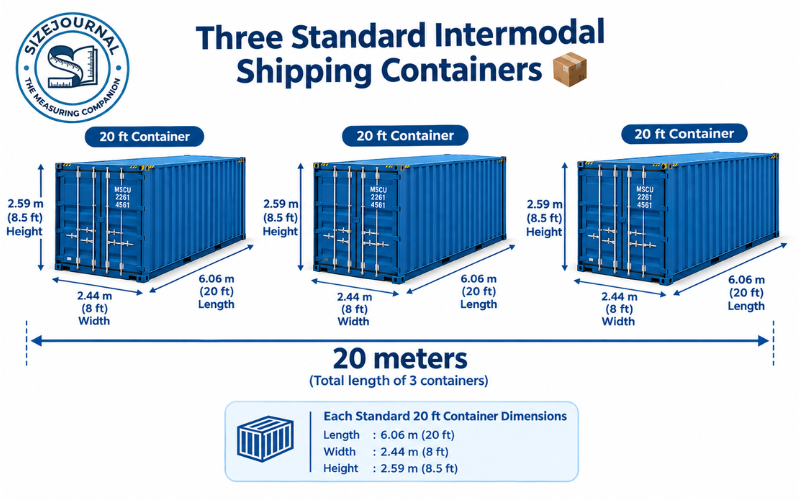
9. Three Standard Intermodal Shipping Containers 📦
Global shipping container dimensions are heavily regulated to fit cargo ships, freight trains, and flatbed trucks smoothly.
The standard short intermodal container (often called a 20-foot container) has an actual length of 6.06 meters. When freight workers arrange three of these steel containers end-to-end in a straight line, the combined layout stretches to roughly 18.2 meters—or just over 20 meters if you are using three slightly larger custom freight modules with minor gaps between them.
10. The Width of a Short-Course Competitive Swimming Pool 🏊
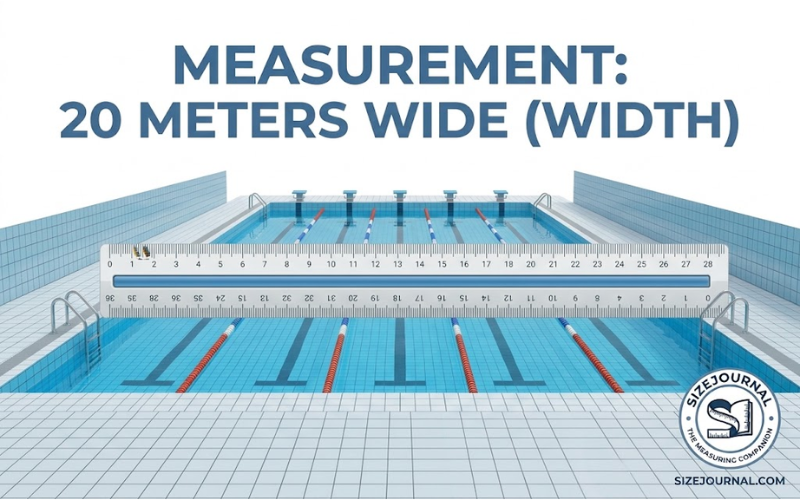
While Olympic racing pools stretch 50 meters long, short-course pools and multi-use aquatic centers are designed around different standard configurations.
Many regional sports facilities feature pools that are 25 meters long and built with a width of approximately 20 meters to accommodate 8 to 10 swimming lanes. Looking across the calm water from one side deck to the far tile wall gives you a clear, unobstructed line of sight straight across a 20-meter distance.
Biowiki Reference Chart 📊
| Object / Visual Reference | Metric Length / Height | Imperial Conversion | Primary Category |
| Two Yellow School Buses | ~20.0 Meters | ~65.6 Feet | Road Transport |
| Regulation Cricket Pitch | 20.12 Meters | 22.0 Yards | Professional Sports |
| Bowling Lane + Approach | ~19.6 Meters | ~64.5 Feet | Recreation |
| Five Mid-Sized Sedans | ~20.0 Meters | ~65.6 Feet | Automobiles |
| Semi-Truck & Trailer | ~20.0 Meters | ~65.6 Feet | Logistics |
| Six-Story Apartment Block | ~20.0 Meters | ~65.6 Feet | Architecture |
| Eight Parking Spaces Wide | ~20.0 Meters | ~65.6 Feet | Urban Planning |
| Mature Oak Canopy Spread | 18.0 – 22.0 Meters | 59 – 72 Feet | Nature / Botany |
| Three Shipping Containers | ~18.2 – 20.0 Meters | ~60 – 65.6 Feet | Shipping |
| Short-Course Pool Width | ~20.0 Meters | ~65.6 Feet | Aquatics |
Related Posts
- 10 Common Things That Are 19 Meters Big
- 10 Common Things That Are 18 Meters Big
- 10 Common Things That Are 17 Meter Big
- 10 Common Things That Are 16 Meters Big
Frequently Asked Questions ❓
How many feet make up 20 meters?
20 meters converts directly to 65.6168 feet. For quick everyday calculations, you can round this to 65.6 feet or about 65 feet and 7 inches.
How many paces does it take to walk 20 meters?
The average adult walking step covers about 0.7 to 0.8 meters. Walking naturally, it will take most adults between 25 and 28 strides to cover a 20-meter distance.
How many yards are in 20 meters?
20 meters is equal to approximately 21.87 yards, which makes it just slightly longer than a standard 20-yard football yardage mark.
Is 20 meters taller than a typical house?
Yes. A single-story suburban house is usually around 3.5 to 5 meters tall, and a two-story home reaches roughly 7 to 8 meters. A height of 20 meters is significantly taller, matching the roofline of a six-story building.
Conclusion 🏁
Understanding spatial measurements becomes effortless once you connect abstract numbers to real-world objects. Knowing that 20 meters translates to roughly 65.6 feet gives you a baseline, but holding mental visuals—like two school buses parked back-to-back, a full cricket pitch, or a six-story building—makes the scale instantly recognizable in everyday life. Whether you are estimating land dimensions, analyzing architecture, or calculating distances on the fly, these ten familiar references make it simple to visualize a 20-meter span wherever you go.
FOR MORE MEASUREMENTS VISIT: SIZE JOURNAL
6 thoughts on “(how big is 20 meter) 10 Common Objects That Are 20 Meters Big”