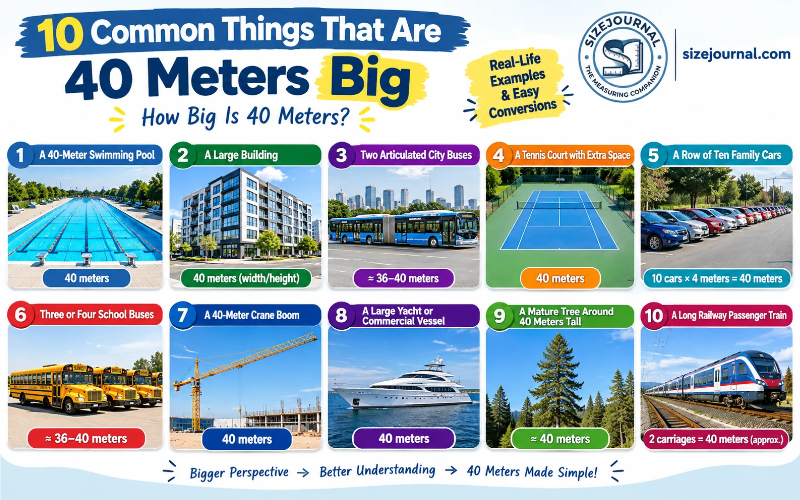
Have you ever wondered how big 40 meters really is? It can be difficult to understand a measurement when you only see it written as a number. Although 40 meters might sound like an ordinary distance, it is long enough to compare with large buildings, swimming pools, sports facilities, and several familiar objects placed together.
The good news is that you do not need a measuring tape stretching across an entire street to understand this length. By comparing 40 meters with things you might see in your neighborhood, at a sports ground, or while traveling, you can develop a much clearer sense of its size.
The key phrase how big is 40 meters becomes easier to understand when you connect it with recognizable measurements. For example, 40 meters is equal to 131.23 feet, 4,000 centimeters, or approximately 43.74 yards. It is also shorter than the length of a standard Olympic swimming pool and longer than a standard tennis court’s playing area.
In this article, we will explore 10 common things that are approximately 40 meters big, long, or tall. We will also look at simple conversions, interesting comparisons, and practical ways to estimate this distance without special equipment.
Quick Answer: How Big Is 40 Meters? 📏
40 meters is approximately 131.23 feet or 43.74 yards. It is a substantial distance that can be compared with a row of ten average-sized cars, a long construction crane boom, or a large yacht.
Here are the essential measurements to remember:
| Measurement | Equivalent |
|---|---|
| Meters | 40 m |
| Feet | 131.23 ft |
| Yards | 43.74 yd |
| Centimeters | 4,000 cm |
| Millimeters | 40,000 mm |
| Kilometers | 0.04 km |
| Inches | 1,574.8 inches |
| Miles | Approximately 0.0249 miles |
A helpful way to remember this measurement is to think of 40 meters as a distance that would take a typical adult several dozen walking steps to cover. Depending on stride length, it may take around 50–60 steps.
Keep in mind that a 40-meter length is not the same as a 40-meter height. A building that is 40 meters tall would be a much more dramatic sight than a building that stretches 40 meters along the ground.
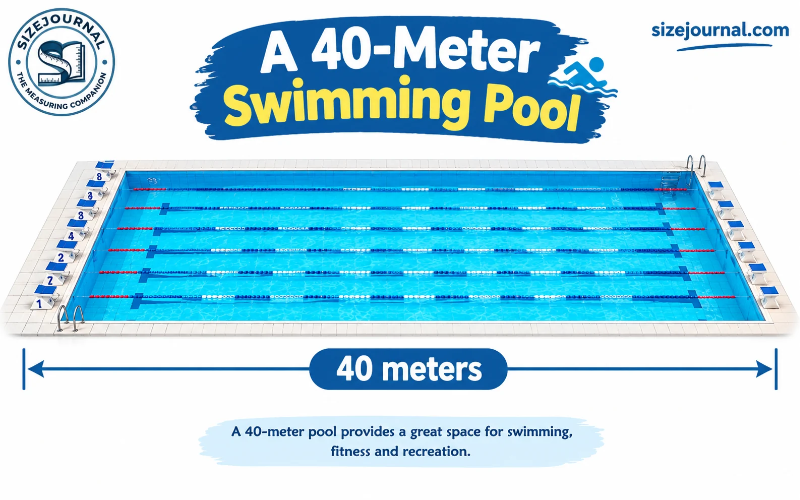
1. A 40-Meter Swimming Pool 🏊
A swimming pool is one of the easiest ways to understand a measurement of 40 meters. Swimming pools are built in recognizable dimensions, making them useful reference points for comparing lengths.
A pool that measures 40 meters from one end to the other would provide a substantial space for swimming practice, recreational activities, and fitness training.
How does a 40-meter pool compare with standard pools?
A standard Olympic-size swimming pool is 50 meters long. Therefore, a 40-meter pool would be 10 meters shorter than an Olympic pool.
That means 40 meters represents 80% of the length of a standard Olympic swimming pool.
A 25-meter short-course pool would be shorter still. A 40-meter pool would extend 15 meters beyond its length.
These comparisons are useful because swimming pools often have clearly marked ends, making their dimensions easier to understand than the length of an irregular outdoor space.
What would 40 meters look like at a swimming facility?
Imagine standing at one end of a 40-meter pool and looking toward the opposite end. The water would stretch far enough to make the distance obvious, especially when lane markings guide your eyes toward the other side.
If you swim from one end to the other, you would cover 40 meters in a single length. Swimming back would bring your total distance to 80 meters.
Interesting fact: A 40-meter pool is not the standard Olympic competition length, but it is a useful example for understanding distances between 25 and 50 meters.
2. A Large Residential or Commercial Building 🏢
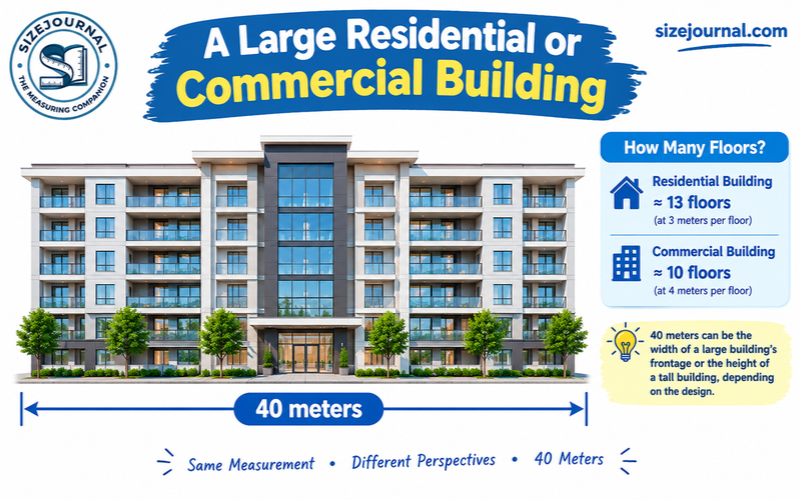
A large building can help explain how big 40 meters is, although it is important to distinguish between height and horizontal length.
A building might measure 40 meters across its front without being anywhere near 40 meters tall. Likewise, a tall building could reach 40 meters vertically while having a much narrower footprint.
How many floors make 40 meters?
The answer depends on the height of each floor.
For a typical residential building, assume each floor is approximately 3 meters high. At that height, 40 meters would equal about 13.3 floor heights.
For a commercial building with floor-to-floor heights of approximately 4 meters, the same height would equal around 10 floors.
These are estimates rather than fixed rules. Buildings vary according to their design, ceiling heights, mechanical floors, and roof structures.
How can you compare this measurement with a building?
If you stand outside a building that is roughly 40 meters wide, you can estimate its frontage by looking at the entrance, windows, and sections of the exterior.
For a height comparison, a 40-meter building would be much taller than a typical two- or three-story house. From street level, it would have a noticeable presence in the surrounding area.
This comparison is especially helpful when you are trying to understand the difference between the horizontal length of an object and its vertical height.
3. Two Articulated City Buses 🚌
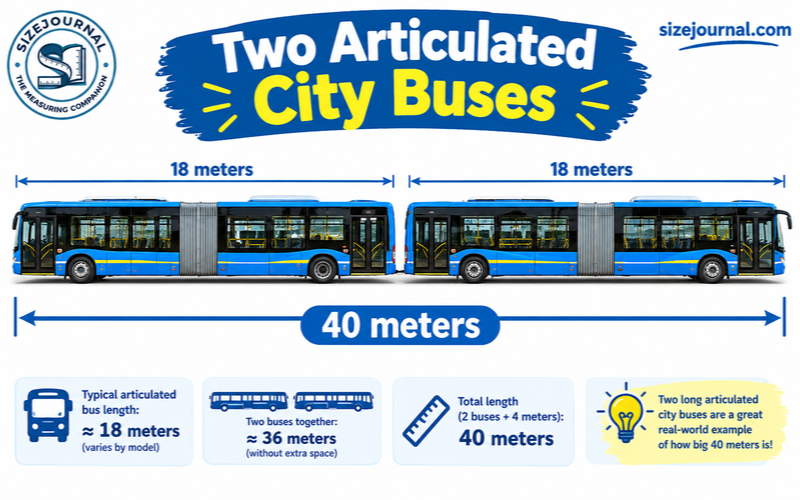
City buses are familiar sights in many urban areas. A standard articulated bus, which has a flexible joint connecting two passenger sections, is often around 18 meters long, although actual lengths vary by model.
Two buses of that size would measure approximately 36 meters when placed end to end. That makes two long articulated buses a useful comparison for understanding a distance close to 40 meters.
For example, two 18-meter articulated buses would cover 36 meters, leaving another 4 meters to reach the full distance.
Why is this a useful comparison?
Vehicles provide a practical way to estimate length because their dimensions are easier to recognize than an unfamiliar measurement. If you have ever seen two long city buses parked in a row, you have already seen something approaching 40 meters.
However, do not assume that every bus has the same dimensions. Smaller city buses, standard single-deck buses, and articulated buses can differ considerably in length.
4. A Tennis Court with Extra Space 🎾
A tennis court is another useful reference because its official dimensions are well established.
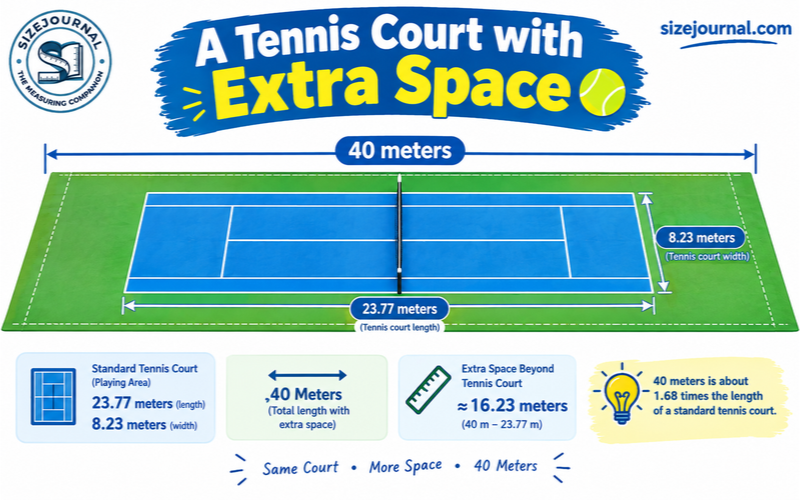
A standard tennis court measures 23.77 meters long between the baselines. Its width is 8.23 meters for singles and 10.97 meters for doubles.
Therefore, 40 meters is significantly longer than the playing length of a tennis court.
How much longer is 40 meters than a tennis court?
Subtract the court length from the 40-meter measurement:
40 − 23.77 = 16.23 meters.
That means 40 meters is approximately 16.23 meters longer than the playing area of a standard tennis court.
Another way to understand this comparison is that 40 meters is about 1.68 times the length of a tennis court.
If you stand behind one baseline and look toward the other, the court provides a useful starting point for visualizing a familiar distance. You would still need another 16 meters or so to reach 40 meters.
Does the surrounding court area count?
Not when you are comparing the official playing dimensions. Tennis facilities often include additional space behind the baselines and beside the sidelines for players to move safely.
If you measure the entire court installation, including those extra areas, the overall dimensions may be larger than the playing surface.
This distinction matters whenever you compare a fixed measurement with a sports facility.
5. A Row of Ten Family Cars 🚗
Cars are excellent everyday references because most people have a general idea of their size.
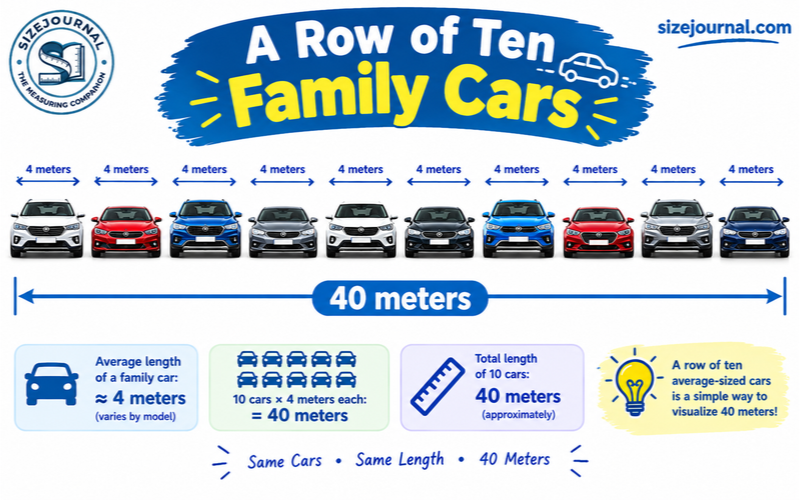
Many ordinary passenger cars measure approximately 4 meters long, although some are shorter and others are substantially longer.
If you place ten cars measuring 4 meters each in a straight line, their combined length would be:
10 × 4 = 40 meters.
This makes a row of ten average-sized cars a simple way to picture the measurement.
What would the line look like?
Imagine ten cars parked bumper to bumper in a straight line. The first car occupies the first 4 meters, the second occupies the next 4 meters, and the pattern continues until all ten cars cover the distance.
The final car would bring the line to approximately 40 meters.
Of course, real cars have different lengths. A row of small hatchbacks may cover less ground, while a line of large SUVs may extend farther.
How can you use cars to estimate 40 meters?
If you are standing in a parking lot, count a line of parked vehicles and use their approximate lengths as a reference.
For a quick estimate, five cars measuring 4 meters each would cover approximately 20 meters. Ten would cover approximately 40 meters.
Remember that this comparison assumes the vehicles touch end to end. Gaps between parked cars would increase the total distance covered by the entire row.
6. Three or Four School Buses 🚌
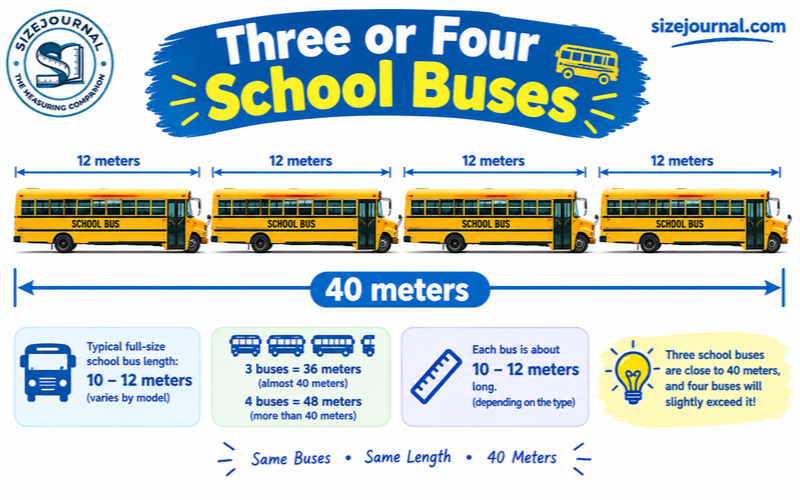
School buses come in a variety of sizes, but many full-size models are approximately 10–12 meters long.
Two full-size school buses placed end to end would therefore cover roughly 20–24 meters. Although that is not enough to reach 40 meters, it offers a helpful starting point for understanding the scale.
If the buses are only 10 meters long, four would be needed to reach exactly 40 meters.
Why do school buses make a good comparison?
Their long, rectangular shapes make their lengths easy to visualize. In addition, school buses are frequently seen outside schools, on roads, and in parking areas.
This comparison is useful when explaining a large measurement to children or anyone who finds abstract numbers difficult to imagine.
Just remember that school bus dimensions vary by country, manufacturer, and vehicle category.
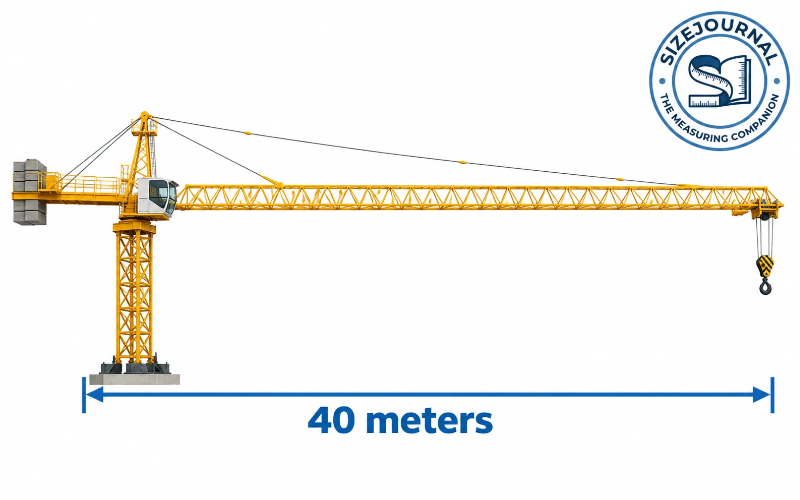
7. A 40-Meter Construction Crane Boom 🏗️
Construction cranes are designed to lift and move materials across large work areas. Their long horizontal arms, often called jibs or booms depending on the crane type, can provide a useful visual comparison for 40 meters.
Some construction cranes have working reaches that are shorter than 40 meters, while others extend much farther. A crane with a 40-meter jib or working reach would provide a direct example of this length.
What does a 40-meter crane boom look like?
Imagine a long horizontal arm stretching across a construction site. It could extend over stored materials, sections of a building, or other areas where lifting work is required.
From ground level, a 40-meter horizontal reach would be substantial. The arm might extend across a large part of the site, depending on its layout.
However, the crane’s boom length, horizontal working radius, and maximum lifting reach are not always identical measurements. The geometry of the crane determines how these distances relate.
How does this compare with ordinary objects?
A 40-meter crane boom is as long as ten cars measuring 4 meters each. It is also longer than a standard tennis court’s playing area.
Unlike a row of cars, however, a crane boom may be elevated above the ground. Its horizontal reach should not be confused with the crane’s overall height.
Safety note: Construction cranes are specialized equipment. Their lifting capacity changes with factors such as working radius, load, configuration, and manufacturer specifications.
8. A Large Yacht or Commercial Vessel ⚓
Boats and yachts come in many different sizes, ranging from small recreational craft to vessels large enough to accommodate numerous passengers and crew members.
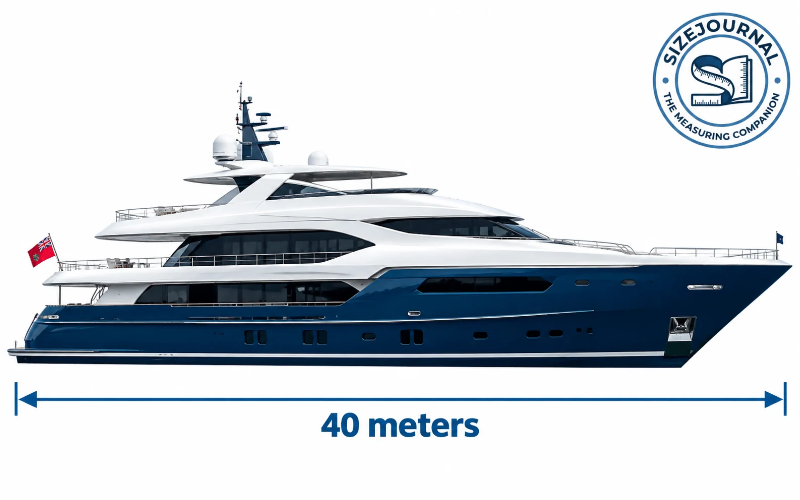
A 40-meter yacht is a substantial vessel. It would be considerably larger than a typical small recreational boat and could have multiple decks, guest accommodations, and dedicated crew areas.
How big is a 40-meter yacht?
A yacht measuring 40 meters from bow to stern is approximately 131 feet long.
To make that measurement easier to understand, compare it with ten cars that are each 4 meters long. The yacht would have approximately the same overall length as that row of vehicles.
However, the yacht’s width, known as its beam, would be much smaller than its length. Its actual appearance would also depend on its hull design, number of decks, and superstructure.
Is every commercial fishing boat 40 meters long?
No. Fishing vessels vary enormously in size. Some are small boats used close to shore, while others are large commercial vessels designed for extended voyages.
A vessel measuring 40 meters would be a large fishing boat in many contexts, but it would not represent the typical size of every fishing vessel.
This comparison works best when you use a specific boat whose published length is close to 40 meters.
Why is this comparison interesting?
Boats demonstrate that a 40-meter object does not need to be particularly tall to be impressive. A long vessel viewed from the side can stretch across a large part of a harbor or marina.
It is also a useful reminder that length and height describe different dimensions.
9. A Mature Tree Around 40 Meters Tall 🌳
Trees offer a striking way to understand 40 meters because their height can be difficult to estimate from the ground.
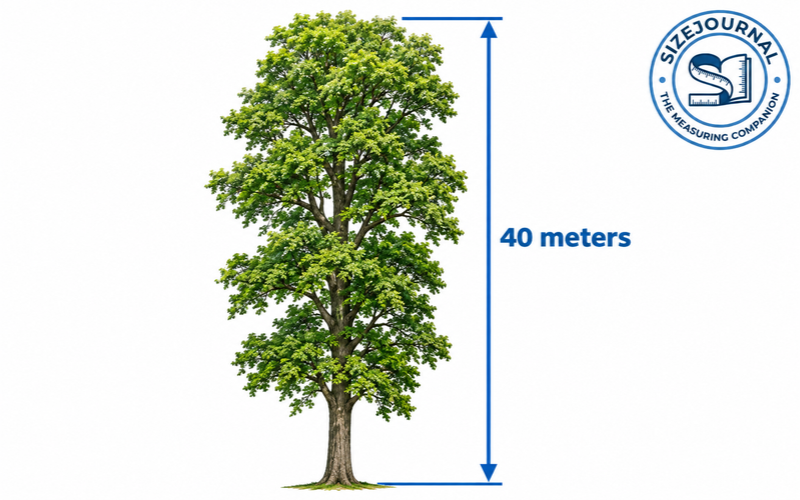
Many trees remain well below this height, but some mature species can reach approximately 40 meters or more under suitable growing conditions.
Examples include certain mature pines, firs, and other tall forest trees. Their eventual height depends on species, age, climate, soil, and growing conditions.
How tall is a 40-meter tree?
A tree measuring 40 meters from the ground to its highest point would be approximately 131 feet tall.
That is a considerable height compared with ordinary residential buildings, garden trees, and street trees.
For another comparison, imagine stacking the height of around 13 floors, each approximately 3 meters high. The total would be about 39 meters, which is very close to the height of the tree.
The actual number of floors in a building of equivalent height would depend on its design.
Can you easily recognize a tree that is 40 meters tall?
It can be difficult to judge tree height accurately without measurements. Looking upward from the base may make a tall tree appear shorter or taller depending on your distance from it and the surrounding landscape.
If you stand farther away, you may be able to see more of the tree’s overall shape and compare it with nearby buildings.
Not every tall tree reaches 40 meters, so this example refers to selected mature trees rather than all trees in general.
Interesting fact: Tree height and tree trunk length are different measurements. A tree may have a 40-meter height while its trunk diameter remains only a small fraction of that distance.
10. A Long Railway Passenger Train 🚆
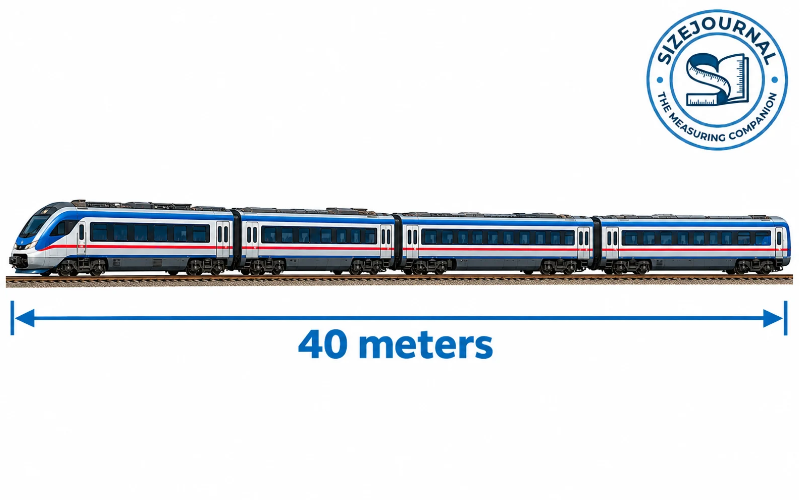
A passenger train is another practical way to understand how big 40 meters is. Trains consist of connected vehicles, and the length of a carriage provides a useful reference for estimating the total distance.
Depending on the type of train, a passenger carriage might measure approximately 20–25 meters long. This means that a single carriage could cover about half of a 40-meter distance or somewhat more.
How many train carriages make 40 meters?
Consider passenger carriages that measure 20 meters each.
- One carriage: 20 meters.
- Two carriages: 40 meters.
With this example, two 20-meter carriages placed together would measure exactly 40 meters.
If the carriages were 25 meters long, one and a half carriage lengths would equal 37.5 meters, which is close to the target.
Actual passenger carriage dimensions vary, so these examples are estimates rather than universal specifications.
What would 40 meters look like at a railway station?
At a station, you can use the visible length of a carriage to estimate the distance along a platform. Two carriages measuring 20 meters each would cover 40 meters.
This can help you understand platform distances, railway layouts, and the size of vehicles used for passenger transportation.
However, a complete passenger train is often much longer than 40 meters because it consists of several connected carriages and may include a locomotive.
The comparison is most useful when focusing on a short section of the train rather than the entire train.
More Everyday Ways to Visualize 40 Meters
The ten examples above provide a useful starting point, but there are other ways to make this measurement easier to remember.
Compare it with a running track
A standard outdoor athletics track has a 400-meter lap in the innermost lane. A distance of 40 meters represents one-tenth of that lap.
This is useful for runners and sports enthusiasts because track markings help them estimate distances.
Compare it with a football field
The dimensions of football fields vary by sport. A soccer pitch, for example, can differ in length depending on the level of competition and the applicable regulations.
A 40-meter distance is shorter than the length of a full-size soccer pitch. It represents a section of the field rather than the entire playing area.
American football fields have different dimensions and markings, so they should be treated as a separate comparison.
Compare it with walking distance
An average adult’s walking stride may cover around 0.7–0.8 meters per step, although this varies with height, pace, and terrain.
Using a stride length of 0.75 meters:
40 ÷ 0.75 ≈ 53 steps.
Therefore, a person might cover 40 meters in approximately 53 steps. This is only a rough estimate, but it is helpful when you do not have a measuring device available.
Compare it with a residential street
Some short driveways, parking areas, and sections of residential streets can extend for around 40 meters. However, street lengths vary considerably, so a measured distance is more reliable than judging by appearance alone.
A 40-meter stretch is long enough to notice when walking from one end to the other, but it is still short compared with a full city block in many urban areas.
How to Convert 40 Meters into Other Units
Understanding unit conversions makes it easier to compare measurements from different countries and sources.
40 meters to feet
One meter equals approximately 3.28084 feet.
Therefore:
40 × 3.28084 = 131.2336 feet.
Rounded to two decimal places, 40 meters equals 131.23 feet.
40 meters to yards
One meter equals approximately 1.09361 yards.
Therefore:
40 × 1.09361 ≈ 43.74 yards.
This means 40 meters is slightly less than 44 yards.
40 meters to centimeters
One meter contains 100 centimeters.
Therefore:
40 × 100 = 4,000 centimeters.
This conversion is useful when working with smaller measurements or using a metric ruler.
40 meters to kilometers
One kilometer equals 1,000 meters.
Therefore:
40 ÷ 1,000 = 0.04 kilometers.
Although 0.04 kilometers may look small, it still represents a distance of 40 meters.
40 meters to inches
One meter equals approximately 39.3701 inches.
Therefore:
40 × 39.3701 ≈ 1,574.8 inches.
This is another useful conversion for people accustomed to the imperial measurement system.
Why Is Understanding 40 Meters Useful? 🤔
Knowing what 40 meters looks like is useful in many everyday situations.
For home and property planning
When planning a garden, driveway, outdoor seating area, or boundary, you may need to estimate a distance before taking exact measurements.
Understanding how 40 meters compares with cars, buildings, and other objects can help you judge whether a space is large enough for your intended purpose.
However, always use accurate measurements before beginning construction or purchasing materials.
For sports and fitness
Runners, swimmers, and other athletes regularly work with measured distances. Knowing the approximate length of a pool or a section of a sports field can help you understand training routines.
For example, swimming 40 meters twice would give you a total distance of 80 meters.
For education
Students often encounter meters in mathematics and science lessons. Comparing a number with familiar objects helps turn an abstract unit into something easier to understand.
Instead of memorizing that 40 meters equals 4,000 centimeters, you can remember a row of ten cars, each approximately 4 meters long.
For travel and transportation
Vehicles, boats, and trains provide practical examples of large dimensions. These comparisons can help when learning about parking layouts, passenger transport, ports, and construction sites.
The important thing is to remember that the stated dimensions of real objects may vary.
BioWiki Table: 40 Meters at a Glance
The following table summarizes the essential facts about this measurement.
| BioWiki Field | Details |
|---|---|
| Measurement | 40 meters |
| Measurement type | Length or distance |
| Symbol | 40 m |
| Equivalent in feet | 131.23 feet |
| Equivalent in yards | 43.74 yards |
| Equivalent in centimeters | 4,000 cm |
| Equivalent in kilometers | 0.04 km |
| Everyday comparison | Ten cars measuring approximately 4 meters each |
| Sports comparison | Longer than a standard tennis court’s playing length |
| Swimming comparison | 80% of a 50-meter Olympic pool |
| Approximate walking steps | 50–60 steps, depending on stride |
| Common uses | Construction, transportation, sports, property planning, and education |
Related Posts
- How Big is 30 Meters? 10 Everyday Things That Are 30 Meters Big
- 10 Common Things That Are 29 Meters Big
- How Big is 28 Meter? 10 Common Objects That Are 28 Meters Big
- How Big is 27 Meters? 10 Everyday Things That Are 27 Meters Big
Frequently Asked Questions (FAQs)
1. How big is 40 meters in feet?
40 meters equals approximately 131.23 feet. This is a useful conversion when comparing metric measurements with buildings, vehicles, and distances described in feet.
2. What common things are 40 meters long?
A row of ten cars measuring approximately 4 meters each would cover 40 meters. Other useful comparisons include a hypothetical 40-meter swimming pool, a crane boom with a 40-meter reach, or a large yacht measuring 40 meters from bow to stern.
The actual dimensions of real objects vary, so these examples should be treated as comparisons rather than universal measurements.
3. How many steps does it take to walk 40 meters?
It may take approximately 50–60 ordinary walking steps to cover 40 meters. The exact number depends on your stride length, walking speed, and the surface you are crossing.
A person with longer strides may need fewer steps, while someone with shorter strides may need more.
4. Is 40 meters a long distance?
Yes, 40 meters is a substantial distance in a small outdoor space, room, or residential setting. However, it is relatively short compared with a running track, road, or long-distance journey.
Whether it feels long depends on the situation. Walking 40 meters is generally quick, but seeing a 40-meter-tall tree or a 40-meter-long vessel can make the measurement feel much more impressive.
5. How many yards are in 40 meters?
There are approximately 43.74 yards in 40 meters. Since one yard equals 0.9144 meters, 40 meters is slightly longer than 43 yards.
6. Is 40 meters longer than a tennis court?
Yes. A standard tennis court’s playing area measures 23.77 meters long. Therefore, 40 meters is 16.23 meters longer than the playing length of the court.
7. How many cars would fit into 40 meters?
Approximately ten cars measuring 4 meters each could cover a total length of 40 meters when placed directly bumper to bumper.
The exact number depends on the size of the vehicles. Smaller cars may allow more vehicles to fit, while larger cars may cover the distance with fewer.
8. How many floors is a 40-meter building?
A 40-meter building could be approximately 10–13 floors tall, depending on the height of each floor. Residential buildings with floor heights of around 3 meters would have approximately 13 floor heights within 40 meters.
Commercial buildings with taller floors may have fewer stories at the same overall height.
9. Is 40 meters the same as 0.04 kilometers?
Yes. There are 1,000 meters in one kilometer, so dividing 40 by 1,000 gives 0.04 kilometers.
10. How can I measure 40 meters without a measuring tape?
You can estimate the distance by counting your steps, using a measured sports court as a reference, or comparing it with known object lengths.
For example, if your average step covers approximately 0.75 meters, you would need around 53 steps to cover 40 meters. For more accurate results, use a measuring wheel, a suitable distance-measuring device, or a properly marked measuring tape.
Conclusion
Understanding how big is 40 meters becomes much easier when you compare it with familiar objects and places. This measurement equals approximately 131.23 feet, 43.74 yards, or 4,000 centimeters.
A row of ten cars measuring 4 meters each provides one of the simplest ways to visualize the distance. Other helpful comparisons include two 20-meter train carriages, a long construction crane boom, and a large yacht measuring 40 meters in length.
You can also use sports facilities, walking steps, and building dimensions to develop a better sense of the measurement. Just remember that the dimensions of real-world objects vary, and length should not be confused with height.
The next time you encounter a distance of 40 meters, you will have several practical examples to help you understand its size.
FOR MORE MEASUREMENTS VISIT: SIZE JOURNAL
1 thought on “10 Common Things That Are 40 Meters Big: How Big Is 40 Meters?”