
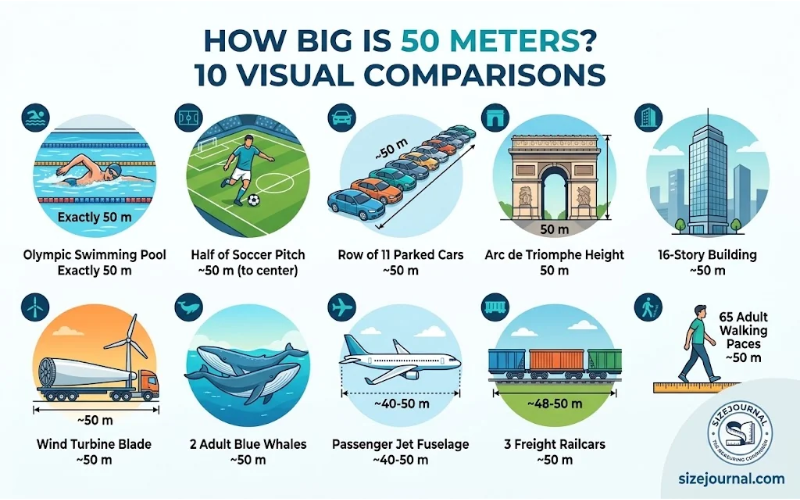
Measurements in meters can easily feel abstract when written out as cold figures on paper. While small distances like one or two meters are easy to grasp—roughly the length of a doorway or a adult step—scaling up to fifty meters stretches beyond quick estimation.
Understanding how big is 50 meters becomes much simpler when grounded in real-world reference points. Equal to exactly 164.04 feet or 54.68 yards, a fifty-meter span represents a substantial physical distance. It is long enough to park a fleet of family vehicles, tall enough to define city skylines, and wide enough to frame major global sporting arenas. Connecting this unit of length to physical objects provides a clear mental ruler for everyday life.
Quick Reference Guide ⏱️
For an immediate mental shortcut without digging into detailed technical specifications, look to a standard competition swimming pool. The distance from one end of an Olympic pool to the other measures precisely fifty meters.
- In Imperial Feet: 164.04 feet
- In Standard Yards: 54.68 yards
- In Adult Walking Steps: Approximately 65 pacing strides
- In Architectural Terms: The approximate height of a 15 to 16-story apartment building
BioWiki Reference: Key Dimensions at a Glance 📊
| Metric Dimension | Imperial Equivalent | Practical Context Benchmark |
| 50 Meters (50 m) | 164.04 Feet | Standard international athletic track length |
| 50 Meters (50 m) | 54.68 Yards | Slightly longer than half a football pitch |
| 50 Meters (50 m) | 1,968.5 Inches | Architectural planning scale |
| 50 Meters (50 m) | ~65 Paces | Average adult walking stride distance |
| 50 Meters (50 m) | ~16 Stories | Height of a mid-rise residential tower |
10 Common Objects That Are Around 50 Meters Big 📏
Exploring real-world structures, vehicles, and biological organisms helps bridge the gap between mathematical units and tangible experience. Here are ten distinct items that showcase fifty meters in action.
1. An Olympic-Sized Swimming Pool 🏊♂️
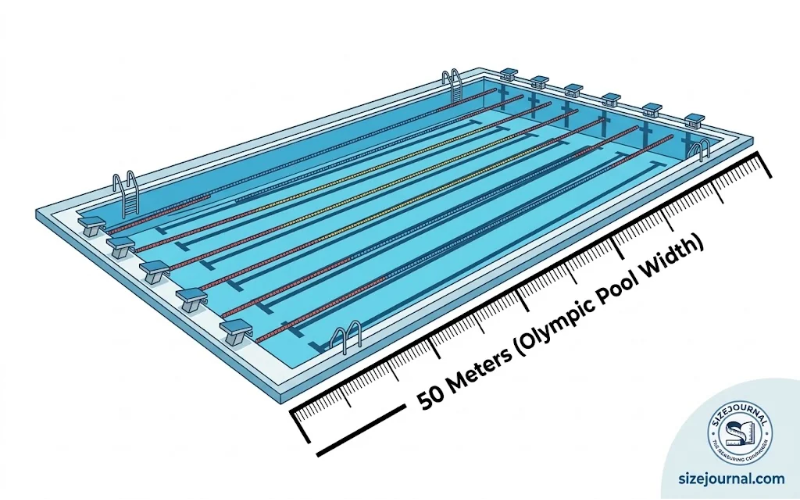
The most exact visual baseline for fifty meters is an official long-course swimming pool used in international championships. Athletic governing bodies mandate that competition pools must measure exactly fifty meters between touch pads.
Swimmers racing back and forth experience every inch of this distance during long-distance heats. Because electronics and touch pads add slight thickness, pool concrete basins are constructed slightly longer to ensure the finished swim lane meets the fifty-meter requirement down to the millimeter.
2. Half of a Professional Soccer Pitch ⚽
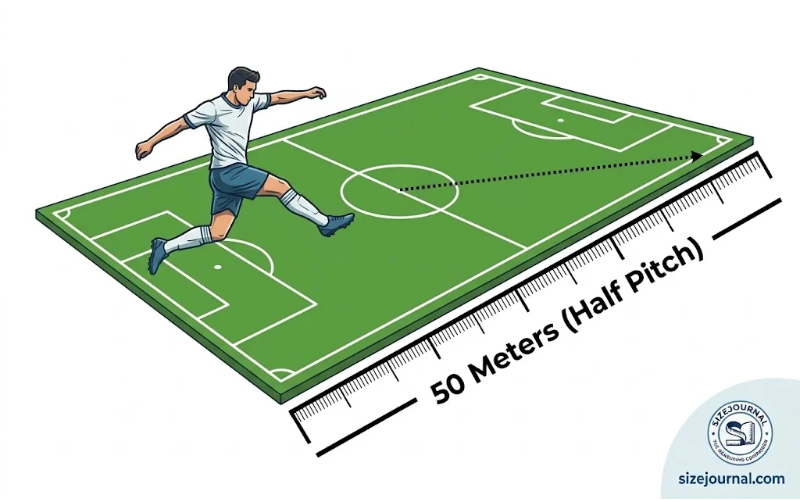
While soccer field dimensions vary slightly depending on regional regulations, top-tier professional stadiums typically feature pitches measuring roughly 105 meters from goal line to goal line.
This structure makes the halfway line a convenient visual marker. From the center circle stripe out to either goal line, players and spectators are looking across a span of roughly fifty meters.
3. A Line of 10 to 12 Parked Sedans 🚗
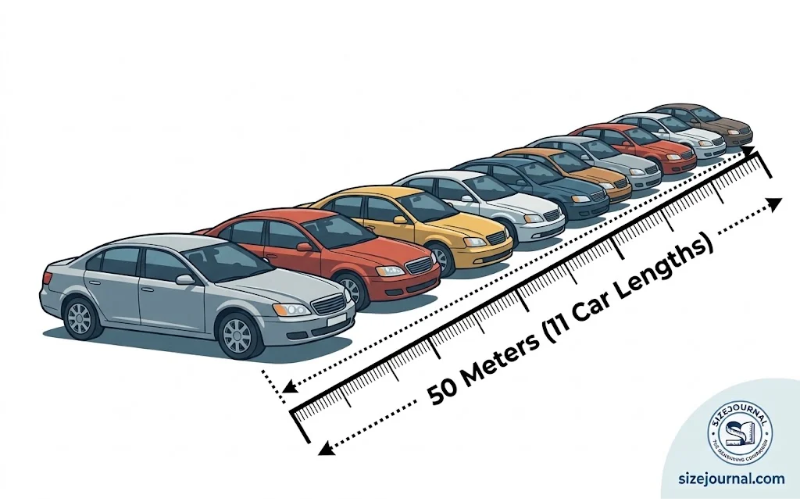
Street-level parking offers an accessible way to measure distance on foot. A standard full-size passenger sedan stretches approximately 4.5 to 4.8 meters from front bumper to rear tail light.
Aligning ten to twelve of these vehicles bumper-to-bumper along a curb creates a continuous line stretching roughly fifty meters long. Walking past a row of parked cars on a city street gives a grounded sense of horizontal scale.
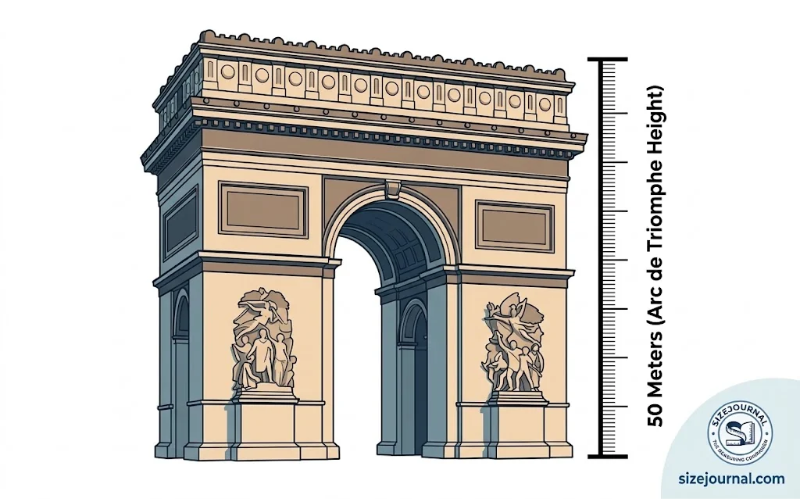
4. The Height of the Arc de Triomphe in Paris 🏛️
Historic architecture features striking examples of fifty-meter vertical scales. The iconic Arc de Triomphe, positioned at the top of the Champs-Élysées in France, reaches an overall height of approximately 50 meters.
Designed as a monument to victory, its massive stonework looms over the surrounding traffic roundabout. Standing near its base and looking up toward the vault gives visitors a clear impression of fifty meters measured vertically into the air.
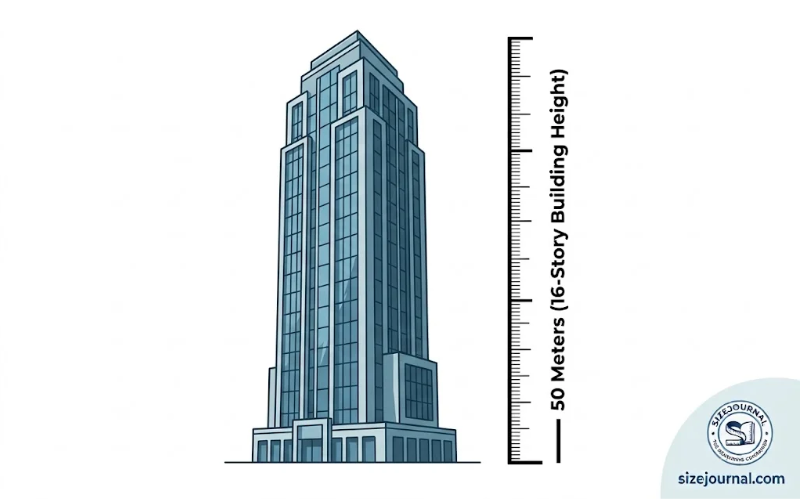
5. A 16-Story Urban Building 🏢
Urban architecture relies on standard floor height standards. Modern residential and commercial towers average roughly three meters per floor once ceiling clearance, utility conduits, and concrete flooring slabs are factored in.
Stacking sixteen floors together results in a structure rising right around fifty meters from ground level. City residents pass buildings of this precise elevation every day without noticing how neatly they match this metric benchmark.
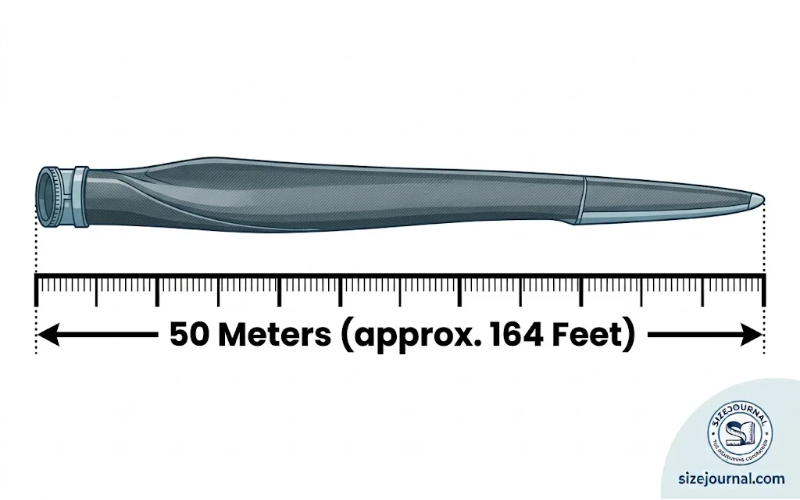
6. A Utility-Scale Wind Turbine Blade 🌬️
Modern renewable energy generation relies on massive physical components to harvest wind power efficiently. On land-based commercial wind farms, individual turbine blades frequently measure between 45 and 55 meters long.
A single blade laying unattached on the ground before tower assembly stretches across an entire construction site, demonstrating how vast modern green technology structures have become.
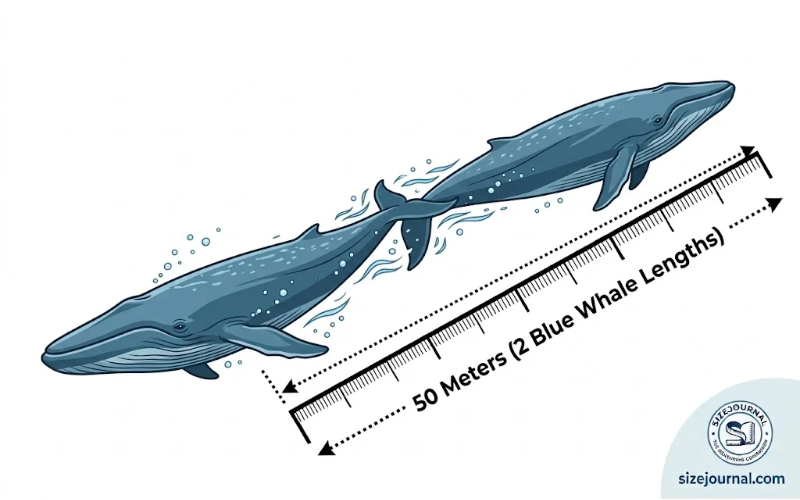
7. Two Fully Grown Blue Whales 🐋
Nature provides fascinating physical points of comparison. The blue whale is officially recognized as the largest animal to ever inhabit the earth, with mature adults growing up to 25 meters in total body length.
Placing two adult blue whales head-to-tail in open water yields a total combined length of roughly fifty meters. Imagining two marine giants lined up together offers a dramatic perspective on natural size limits.
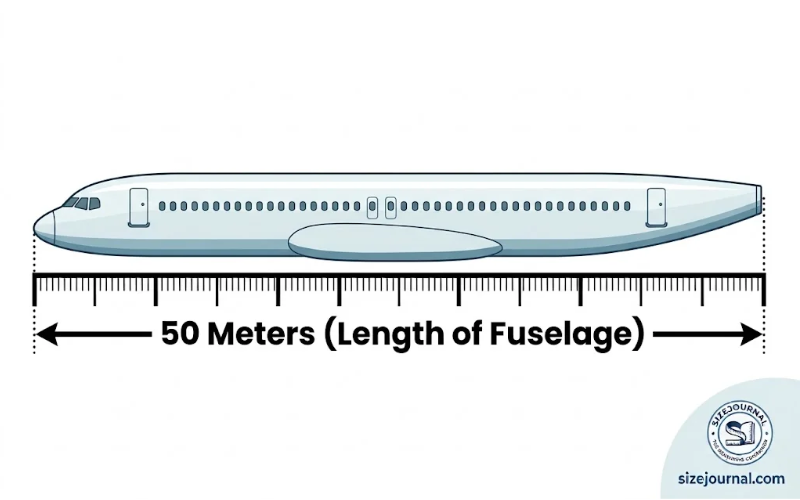
8. A Commercial Jetliner Fuselage ✈️
Aviation design offers another practical baseline. Popular narrow-body commercial airliners configured for medium-haul routes feature main fuselages spanning roughly 40 to 50 meters from flight deck to tail cone.
Passengers walking down the aisle during boarding are traversing a contained tube nearly fifty meters long, making commercial air travel a routine encounter with this physical dimension.
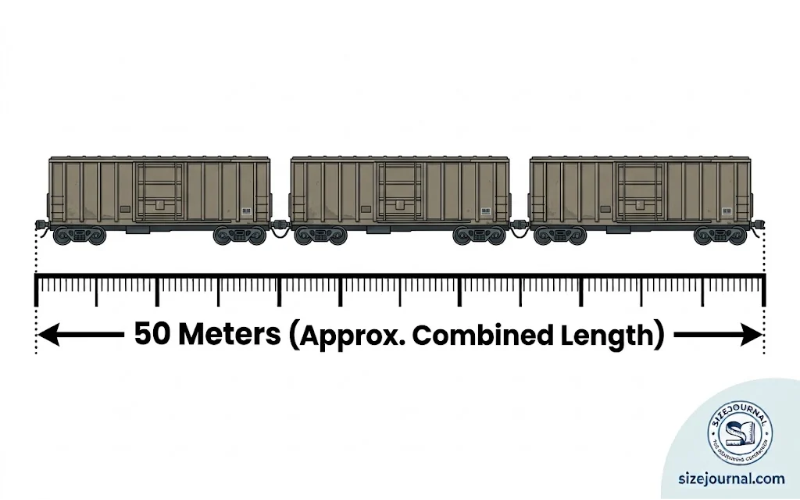
9. Three Coupled Freight Railcars 🚂
Industrial rail transit relies on uniform wagon sizes to streamline logistics. Standard boxcars and hopper cars used across freight networks measure roughly 50 feet (around 15.2 meters) in length each.
When three of these heavy steel freight cars are linked together behind a locomotive, their cumulative length—including coupling hitches—totals approximately 48 to 50 meters across the tracks.
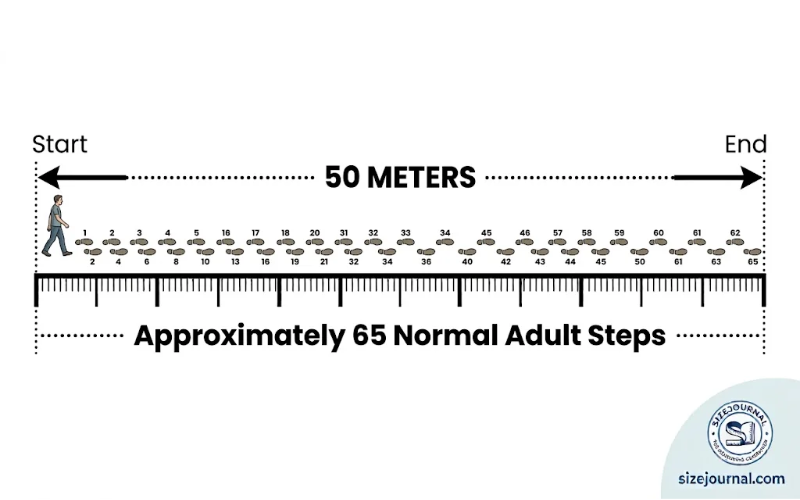
10. Approximately 65 Normal Adult Steps 🚶
When measuring tools are absent, human stride length serves as a reliable personal gauge. An average adult taking natural walking steps covers roughly 0.75 meters per stride.
Counting out 65 steady paces in a straight line covers a distance of approximately fifty meters. This pacing method provides a quick way to estimate field boundaries, garden plots, or outdoor event spaces on the go.
Practical Metric and Imperial Conversions 📐
Navigating conversions between metric units and imperial equivalents makes site planning, sports tracking, and project estimation straightforward.
Related Posts
- 10 Common Things That Are 40 Meters Big: How Big Is 40 Meters
- How Big is 30 Meters? 10 Everyday Things That Are 30 Meters Big
- 10 Common Things That Are 29 Meters Big
- How Big is 28 Meter? 10 Common Objects That Are 28 Meters Big
Frequently Asked Questions ❓
How long does it take to walk 50 meters?
Walking at a standard, comfortable pace of 1.4 meters per second, an adult covers fifty meters in roughly 35 seconds. A hurried stride can cut that time down to under 25 seconds.
Is 50 meters longer than a football field?
No, fifty meters is shorter than a football gridiron. A full American football field measures 120 yards (roughly 109.7 meters) including both end zones. Fifty meters is roughly equivalent to half of the total playing area.
Is 50 meters equal to 50 yards?
No, fifty meters is noticeably longer than fifty yards. Because one meter measures approximately 1.09 yards, fifty meters grants an extra 4.68 yards of distance over a fifty-yard line.
How far away can you identify a person across 50 meters?
Under clear outdoor lighting, human vision easily recognizes familiar people and distinguishes major features across a fifty-meter gap. However, reading fine print or observing minor facial expressions generally requires standing much closer.
Conclusion 🎯
Visualizing spatial dimensions becomes second nature when abstract numbers are tied to recognizable landmarks. Fifty meters—or roughly 164 feet—serves as a core baseline across architecture, sports, transport, and nature. From the length of an Olympic swimming pool and the height of historic monuments to lines of parked cars and long train cars, this measurement forms a foundational part of our physical environment. Keep these comparisons in mind next time you need to estimate spatial distances accurately without a tape measure in hand.
FOR MORE MEASUREMENTS VISIT: SIZE JOURNAL